

 English
 Bahasa Melayu
BAZ’s First Position: Baitul Maqdis in the Hadith Is al-Masjid al-Aqsa in the Qur’an
Series: The Incident of Quraysh Questioning the Prophet About Baitul Maqdis
Introduction
The previous six articles examined the incident in which Quraysh questioned the Prophet SAW about Baitul Maqdis from the angles of narration, sequence of events, the figures involved, the wording used and the geographical indications that appear in the hadith. The next six articles, including this one, present the BAZ positions that arise from that analysis.
This position is not a view issued at random. It is also not a conclusion made out of a desire to support one location or reject another hastily. This position is presented after all narrations were read carefully, the important wordings were separated and every party within the incident was placed in its proper position.
Therefore, I hope this section of opinion will not be read separately from the six earlier analyses. Read the basis of the study first, then evaluate the position I present. The following sections should also be read together with this one.
I do not want you to accept everything I present wholesale without examining it. I also do not want you to reject it blindly before understanding how this conclusion was built.
Once everything is clear, it is entirely up to you whether you wish to accept or reject BAZ’s position. But that evaluation, whether to accept or reject, must be made honestly.
Read carefully. Weigh my argument fairly. Do not come with a decision already fixed in your mind, then only search for sentences that support what you already want to believe. Truth will not appear to a person who reads with bias.
How to Read This Article So That the Qur’an and Hadith Are Not Separated
This article must be read with one clear method so that the discussion does not become confused.
- First, we must look at the wording used by the Qur’an.
- Second, we must look at the wording used in the hadith.
- Third, we must determine whether both wordings belong to the same incident or not.
In Surah al-Isra’ verse 1, the Qur’an mentions the destination of the Isra’ with the wording:
الْمَسْجِدِ الْأَقْصَى
al-Masjid al-Aqsa
In the hadith, the place to which the Prophet SAW went in that incident is mentioned with the wording:
بَيْتُ الْمَقْدِسِ
Baitul Maqdis
For that reason, I do not want to begin this discussion from modern maps, widely accepted history or names that have long been attached to common reading. This discussion must begin from the wording first. The wording of the Qur’an must be read as the wording of the Qur’an. The wording of the hadith must be read as the wording of the hadith. Only after that do we look at whether both are pointing to the same incident.
Once it is clear that both belong to the incident of Isra’, then al-Masjid al-Aqsa in the Qur’an and Baitul Maqdis in the hadith cannot be separated as though the Prophet SAW went to two different places.
This is the way this article should be read. It is not BAZ’s free interpretation. It merely rearranges the wording of the Qur’an, the wording of the hadith and the incident of Isra’ so that readers do not separate two names that actually belong to the same incident.
The Objective of This Article
This article has one objective that is more specific than merely saying that Baitul Maqdis and al-Masjid al-Aqsa refer to the same place. In common reading today, Baitul Maqdis and al-Masjid al-Aqsa are generally assumed to refer to the same place in Palestine. But this article does not treat the popularity of common reading as conclusive evidence.
My discussion stands at a more foundational point. Before the true location of that place is reassessed, we must first lock the point that Baitul Maqdis in the hadith and al-Masjid al-Aqsa in the Qur’an cannot be separated within the same incident of Isra’.
This series is not the only series I use to evaluate the location of Palestine. Other series have been written before this. But in this article, the focus is only one, which is to first unite the Qur’anic designation and the hadith designation within the same incident.
After that basis is locked, only then can the true location of that same place be evaluated through evidence, wording, sequence of events and geographical characteristics.
Before Testing the Location, These Two Names Must Be United
Before we enter the evaluation of location, one matter must first be locked. Baitul Maqdis in the hadith and al-Masjid al-Aqsa in the Qur’an cannot be separated.
The Qur’an mentions the destination of Isra’ as:
الْمَسْجِدِ الْأَقْصَى
al-Masjid al-Aqsa
The hadith mentions the place to which the Prophet SAW went as:
بَيْتُ الْمَقْدِسِ
Baitul Maqdis
Therefore, the main issue I want to raise is not merely, “Do these two wordings refer to the same place?”
If the issue were only that, then the answer is already considered yes and settled. The more important issue is that when the true location of that place is reassessed, both of these names must move together.
If al-Masjid al-Aqsa is evaluated as being in one place, then Baitul Maqdis must also be in the same place. Two wordings that refer to the same incident of Isra’ cannot be separated into two different locations.
Thus, if someone says that the place is in Palestine, then he must place al-Masjid al-Aqsa and Baitul Maqdis together in Palestine. If in my study that place is evaluated as more accurately being in Kedah, then al-Masjid al-Aqsa and Baitul Maqdis must also be read together in Kedah.
One name cannot be placed in Palestine and another name in Kedah. Al-Masjid al-Aqsa cannot be separated from Baitul Maqdis as though both refer to two different locations within the same incident of Isra’.
This is the foundational purpose of this article. I do not want to split the two names. I want to first unite the Qur’anic designation and the designation of the Prophet SAW in the hadith. Only after that can the true location of that same place be reassessed.
If the location is proven to be in Palestine, then both are in Palestine. If the location is proven to be in Lembah Bujang, then both are in Lembah Bujang.
The Meaning of Isra’ According to Qur’anic Usage
The wording Isra’ comes from the Qur’anic expression:
أَسْرَىٰ بِعَبْدِهِ لَيْلًا
“He took His servant by night.”
Surah al-Isra’ 17:1
In Qur’anic usage, this journey is not an ordinary journey initiated by a human being. It is attributed to Allah as His act upon His servant.
A similar usage can be seen when Allah commanded Prophet Musa AS to take His servants by night:
فَأَسْرِ بِعِبَادِي لَيْلًا
“So travel by night with My servants.”
Surah ad-Dukhan 44:23
Therefore, from the angle of Qur’anic usage, Isra’ is a night journey under the command, arrangement and will of Allah. This matters because the destination of Isra’ cannot be separated from the wording that Allah Himself uses in Surah al-Isra’ verse 1.
The Meaning of al-Masjid According to Qur’anic Usage
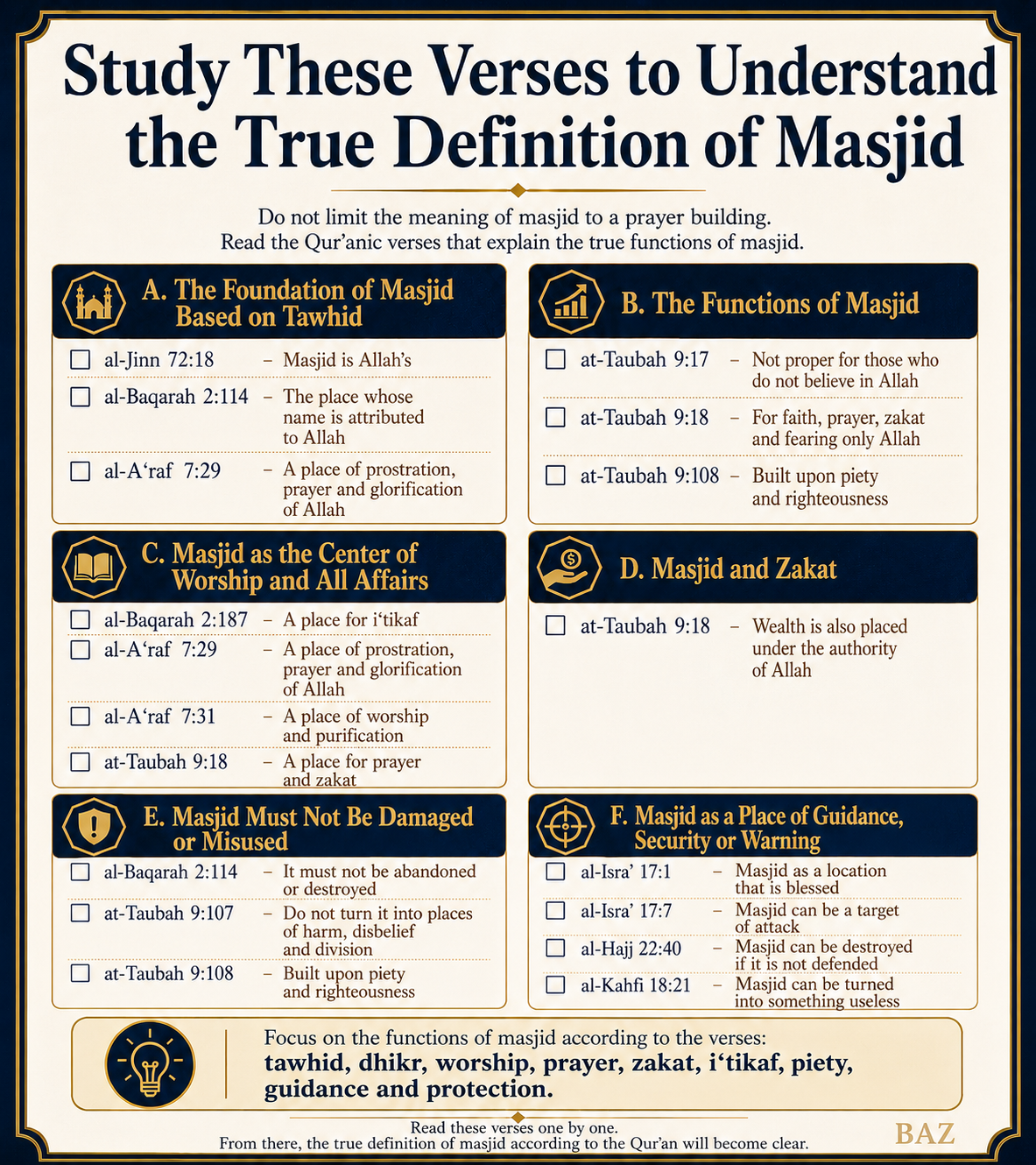
The word masjid in the Qur’an cannot be reduced merely to a prayer building in the modern sense. The Qur’an uses the word masjid as a place of sujud, a place of worship, a place where the name of Allah is mentioned and a place that carries a particular law of sanctity.
Allah says:
وَأَنَّ الْمَسَاجِدَ لِلَّهِ
“And indeed, the masjids belong to Allah.”
Surah al-Jinn 72:18
Allah also mentions masjid as a place where His name is mentioned:
وَمَنْ أَظْلَمُ مِمَّن مَّنَعَ مَسَاجِدَ اللَّهِ أَن يُذْكَرَ فِيهَا اسْمُهُ
“And who is more unjust than one who prevents the masjids of Allah from having His name mentioned therein?”
Surah al-Baqarah 2:114
In another verse, masjid is mentioned together with places of worship in which the name of Allah is mentioned much:
وَمَسَاجِدُ يُذْكَرُ فِيهَا اسْمُ اللَّهِ كَثِيرًا
“And masjids in which the name of Allah is much mentioned.”
Surah al-Hajj 22:40
Therefore, when the Qur’an mentions al-Masjid al-Aqsa, the word masjid must be read according to the Qur’an’s own usage. It is not merely a modern building, not merely a domed structure and not a political name constructed later.
It is a field of sujud, a field of worship and a place that Allah connects to the journey of the Prophet SAW in the incident of Isra’.
The Meaning of al-Aqsa According to Qur’anic Usage
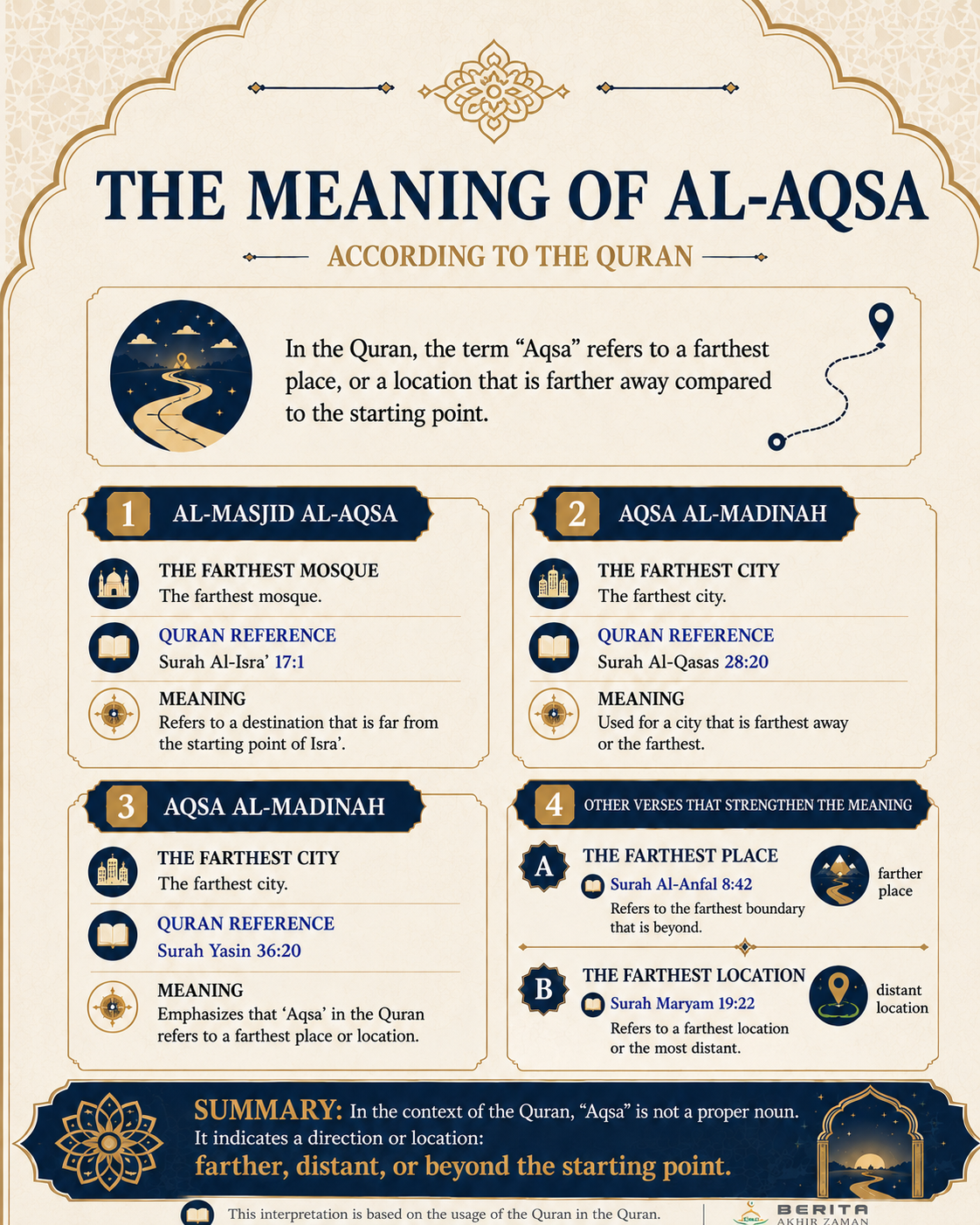
The word al-Aqsa carries the meaning of distant, farthest or being at the edge in terms of distance.
The Qur’an uses this wording in the description of a man coming from the farthest part of a city:
وَجَاءَ رَجُلٌ مِّنْ أَقْصَى الْمَدِينَةِ يَسْعَىٰ
“And a man came from the farthest end of the city, hastening.”
Surah al-Qasas 28:20
The same wording is also used in Surah Yasin:
وَجَاءَ مِنْ أَقْصَى الْمَدِينَةِ رَجُلٌ يَسْعَىٰ
“And there came from the farthest end of the city a man, hastening.”
Surah Yasin 36:20
In the battlefield of Badr, the Qur’an uses a word from the same root to describe the farther position:
وَهُم بِالْعُدْوَةِ الْقُصْوَىٰ
“And they were at the farther side.”
Surah al-Anfal 8:42
Therefore, al-Aqsa in Surah al-Isra’ 17:1 carries an indication of distance and position. It is not an empty name. When Allah mentions al-Masjid al-Aqsa, the wording itself signals that the place was located at a distant position compared to the starting point of Isra’, namely al-Masjid al-Haram.
The Meaning of Bayt According to Qur’anic Usage
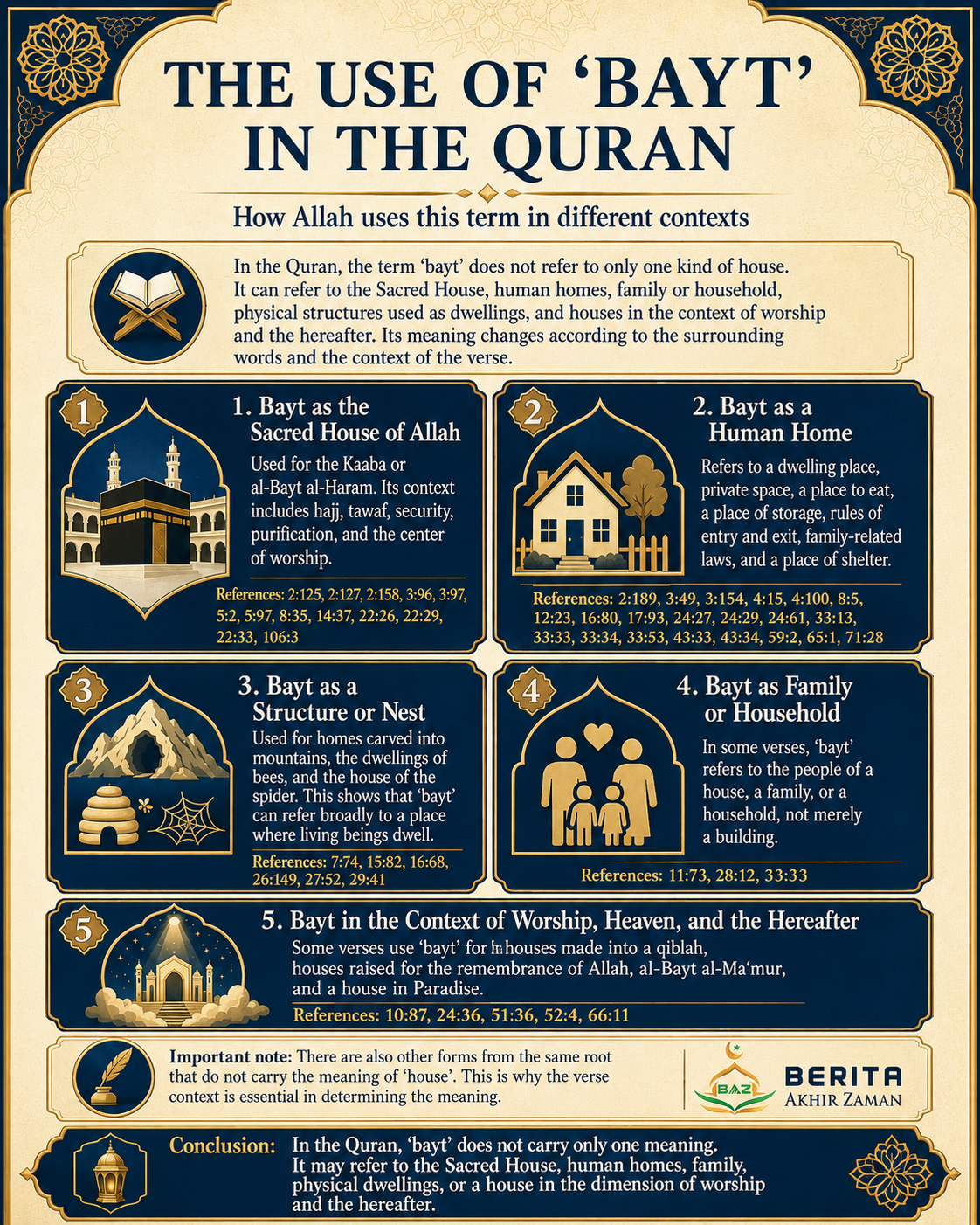
The word bayt in the Qur’an is used for a house, a focal center, a place of return, a place of worship and a place that is sanctified.
Regarding the Kaabah, Allah says:
وَإِذْ جَعَلْنَا الْبَيْتَ مَثَابَةً لِّلنَّاسِ وَأَمْنًا
“And when We made al-Bayt a place of return for the people and a place of security.”
Surah al-Baqarah 2:125
In the same verse, Allah says:
أَن طَهِّرَا بَيْتِيَ
“That you both purify My House.”
Surah al-Baqarah 2:125
Allah also says:
إِنَّ أَوَّلَ بَيْتٍ وُضِعَ لِلنَّاسِ لَلَّذِي بِبَكَّةَ مُبَارَكًا
“Indeed, the first House set up for mankind is the one at Bakkah, blessed.”
Surah Ali ‘Imran 3:96
In Surah al-Ma’idah, Allah connects the word bayt with the Kaabah:
جَعَلَ اللَّهُ الْكَعْبَةَ الْبَيْتَ الْحَرَامَ
“Allah has made the Kaabah, al-Bayt al-Haram.”
Surah al-Ma’idah 5:97
Therefore, bayt in Qur’anic usage is not merely an ordinary house. In the context of worship, bayt is a center that carries sanctity, purification, security, blessing and a connection to human worship of Allah.
When the hadith mentions Baitul Maqdis, the word bayt should not be read loosely. It must be read as a sacred place, a place of worship and a center connected to purification.
The Meaning of Muqaddas According to Qur’anic Usage
The word maqdis comes from the same root as the word muqaddas, which carries the meaning of sacred, sanctified or separated from impurity.
The Qur’an uses this wording for land:
يَا قَوْمِ ادْخُلُوا الْأَرْضَ الْمُقَدَّسَةَ
“O my people, enter the sacred land.”
Surah al-Ma’idah 5:21
The Qur’an also uses this wording for a valley:
إِنَّكَ بِالْوَادِ الْمُقَدَّسِ طُوًى
“Indeed, you are in the sacred valley of Tuwa.”
Surah Taha 20:12
The same wording is repeated in Surah an-Nazi‘at:
إِذْ نَادَاهُ رَبُّهُ بِالْوَادِ الْمُقَدَّسِ طُوًى
“When his Lord called to him in the sacred valley of Tuwa.”
Surah an-Nazi‘at 79:16
Therefore, maqdis cannot be read as an empty name disconnected from its original meaning. It carries the element of sanctification.
When the hadith mentions Baitul Maqdis, it carries the meaning of “sacred house” or “sacred place”, in line with Qur’anic usage of the word muqaddas for land and valley that are sanctified.
The Boundary of Using Surah al-Isra’ Verse 1
In the Qur’an, the destination of Isra’ is mentioned as:
الْمَسْجِدِ الْأَقْصَى
al-Masjid al-Aqsa
Surah al-Isra’ 17:1
Here I want to clarify one boundary so that my argument will not later be manipulated. I am not determining whether Surah al-Isra’ verse 1 was revealed together with the incident of the Prophet SAW’s verification before Quraysh or after it.
That matter is not the focus of this discussion.
The purpose of using Surah al-Isra’ 17:1 here is to show that the Qur’an names the destination of Isra’ as al-Masjid al-Aqsa, while the hadith narrations record the same place with the wording Baitul Maqdis.
Therefore, what I am comparing here is the difference in wording between the Qur’an and hadith within the framework of the same incident, not the specific time of revelation of the verse.
This article also does not make Surah al-Isra’ 17:1 the sole proof for determining geographical location directly. This verse is used to establish the Qur’anic name for the destination of Isra’.
As for evaluating the location, that requires a combination of other evidence, including the wording of the hadith, the sequence of events, the questioning of Quraysh, the description of the place and the geographical characteristics that appear in the narrations.
With this boundary, Surah al-Isra’ 17:1 is not manipulated as though this article is forcing a particular location through one wording alone. The function of this verse in this article is to establish that the Qur’an names the destination of Isra’ as al-Masjid al-Aqsa.
Who First Informed People About That Night Journey?
When we read the incident of Quraysh questioning the Prophet SAW about Baitul Maqdis, we need to distinguish between two matters.
The first matter is who first informed people about that night journey.
The second matter is who first turned Baitul Maqdis into a subject of verification.
From the angle of reporting or narration, this incident began with the Prophet SAW himself. He was the one who informed Quraysh that he had been taken on a night journey. Quraysh did not initiate the report of Isra’. Abu Jahl did not initiate the report of Isra’. The mushrik man also did not initiate the report of Isra’. That report came from the Prophet SAW.
But after the Prophet SAW informed them of the incident, Quraysh turned it into a subject of mockery and verification. That is where Baitul Maqdis began to become the subject of discussion.
Therefore, the sequence of events must be read clearly. The Prophet SAW brought the report of Isra’. Then Quraysh denied and mocked it. After that, they turned the destination of that journey into a subject of testing.
This distinction matters because there are two layers of the incident that cannot be mixed.
The first layer is the reporting of Isra’. This began with the Prophet SAW.
The second layer is the testing of the destination of Isra’. This began when Quraysh denied him, then turned that place into a subject of verification.
Therefore, when this article discusses Baitul Maqdis as the subject of Quraysh’s questioning, it does not mean Quraysh created the report of Isra’. The report of Isra’ came from the Prophet SAW. Quraysh only turned the destination of Isra’ into a field of testing against his claim.
Baitul Maqdis as the Hadith Designation for the Same Destination
In the hadith narrations that were examined previously, the place to which the Prophet SAW went in the incident of Isra’ is mentioned with the wording Baitul Maqdis. At the same time, the Qur’an mentions the destination of Isra’ as al-Masjid al-Aqsa.
Therefore, these two wordings cannot be separated in the context of the incident of Isra’. The wording differs, but the incident being discussed is the same. The Qur’an gives that destination its revealed name with the wording al-Masjid al-Aqsa. The hadith narrations record the same place with the wording Baitul Maqdis.
Thus, when we read the hadith that mentions Baitul Maqdis in the incident of Isra’, that place must be read together with Surah al-Isra’ 17:1, which mentions al-Masjid al-Aqsa. Likewise, when we read al-Masjid al-Aqsa in Surah al-Isra’ 17:1, that place must be read together with the hadith narrations that mention Baitul Maqdis.
This is the safer way of reading so that the Qur’an and hadith are not separated within the same incident.
Baitul Maqdis and al-Masjid al-Aqsa Belong to the Same Incident
This matter must be emphasized once again. Baitul Maqdis and al-Masjid al-Aqsa are not two different incidents. The Qur’an mentions the journey of the Prophet SAW from al-Masjid al-Haram to al-Masjid al-Aqsa. The hadith states that the Prophet SAW came to Baitul Maqdis, then Quraysh questioned him about matters related to that place.
Therefore, the framework of the incident is the same. The Prophet SAW was taken on a night journey. The destination is mentioned in the Qur’an as al-Masjid al-Aqsa. In the hadith, the same place appears with the wording Baitul Maqdis.
For that reason, I do not read Baitul Maqdis in the hadith as a place separate from al-Masjid al-Aqsa in the Qur’an. It is the same place within the same incident, but mentioned through two different fields of wording.
These Two Names Cannot Be Separated in the Incident of Isra’
If someone holds that the destination of Isra’ was in Palestine, then he is in fact placing al-Masjid al-Aqsa and Baitul Maqdis together in Palestine.
If BAZ’s study evaluates that the destination of Isra’ is more accurately located in Kedah, then both must also move together to Kedah.
One term cannot be placed in Palestine and the other term in Kedah, because in the incident of Isra’ the Qur’an and hadith are referring to the same destination through two different wordings.
With this, the position of this article becomes clear. Our discussion is not to separate al-Masjid al-Aqsa from Baitul Maqdis. Our discussion is to reassess where the true location of that same place is.
If the location is proven to be in Palestine, then both are in Palestine. If the location is proven to be in Kedah, then both are in Kedah. What must be rejected is a reading that turns the two wordings into two separate locations within the same incident of Isra’.
A Note Outside the Scope of This Article
As an additional note outside the scope of this article, the wording al-Masjid al-Aqsa should also not be severed from the Qur’anic framework of terms related to the blessing of place, the surrounding area, the direction of rising and sacred land.
Among the wordings that will be discussed in another series are:
بَارَكْنَا حَوْلَهُ
“We blessed its surroundings.”
Surah al-Isra’ 17:1
الَّتِي بَارَكْنَا فِيهَا
“Which We blessed.”
Surah al-A‘raf 7:137
مَشَارِقَ الْأَرْضِ وَمَغَارِبَهَا
“The places of rising of the earth and the places of its setting.”
Surah al-A‘raf 7:137
الْأَرْضَ الْمُقَدَّسَةَ
“The sacred land.”
Surah al-Ma’idah 5:21
الْوَادِ الْمُقَدَّسِ طُوًى
“The sacred valley, Tuwa.”
Surah Taha 20:12
However, this article has not yet proven that all those terms refer to the same location. This article only locks one early foundation, namely that Baitul Maqdis in the hadith and al-Masjid al-Aqsa in the Qur’an cannot be separated within the incident of Isra’.
Closing
Although the wording used differs, Baitul Maqdis in the hadith and al-Masjid al-Aqsa in the Qur’an refer to the same destination in the incident of Isra’. The Qur’an mentions that destination as al-Masjid al-Aqsa. The hadith mentions the same place with the wording Baitul Maqdis.
This article has not yet entered the proof of location. This article only locks the foundation of terminology first.
After these two names have been united, only then can the next BAZ position enter a more specific question:
Which is larger, and which one is inside the other?
Is al-Masjid al-Aqsa inside Baitul Maqdis, or is Baitul Maqdis actually inside the field of al-Masjid al-Aqsa?

Reply to: