

 English
 Bahasa Melayu
Knowledge Is Sought, Experience Is Reflected Upon, Understanding Is Granted by Allah
Introduction
We often assume that once we have read a piece of knowledge, we already know it and have fully understood it. In reality, the Quran teaches us that human beings begin in a state of knowing nothing. Then Allah grants them the tools of understanding: hearing, sight and hearts.
Allah SWT says:
وَٱللَّهُ أَخْرَجَكُم مِّنۢ بُطُونِ أُمَّهَـٰتِكُمْ لَا تَعْلَمُونَ شَيْـًۭٔا وَجَعَلَ لَكُمُ ٱلسَّمْعَ وَٱلْأَبْصَـٰرَ وَٱلْأَفْـِٔدَةَ ۙ لَعَلَّكُمْ تَشْكُرُونَ ٧٨
And Allah brought you out from the wombs of your mothers while you knew nothing, and He gave you hearing, sight and hearts so that you may be grateful.
Surah an-Naḥl 16:78
This means that Allah brings human beings out from the wombs of their mothers in a state of knowing nothing. Then He gives them hearing, sight and hearts so that they may be grateful. This verse shows that knowledge does not originally belong to human beings. It begins as a gift from Allah.
Therefore, knowledge must be sought. Experience must be reflected upon. Yet understanding is not merely the product of human intellect. True understanding is a gift from Allah to whomever He wills.
This does not mean that we may abandon the effort to learn. In religion, the fact that Allah gives does not cancel human effort. We still have to read, review, ask, examine evidence and correct ourselves when we are mistaken. The point is that our effort is only a means. The opening of true understanding remains under the will of Allah.
Repeated Reading Opens Layers of Understanding
In the Quran, we are not only instructed to read. We are also instructed to do tadabbur, which means to examine, reflect repeatedly and think deeply about meaning.
Allah says:
أَفَلَا يَتَدَبَّرُونَ ٱلْقُرْءَانَ أَمْ عَلَىٰ قُلُوبٍ أَقْفَالُهَآ ٢٤
Do they not then reflect deeply upon the Quran? Or are there locks upon their hearts?
Surah Muḥammad 47:24
Allah also mentions that the Quran was revealed as a blessed Book so that people may reflect upon its verses and so that people of sound intellect may take reminder. The reference is Surah Ṣād 38:29:
كِتَـٰبٌ أَنزَلْنَـٰهُ إِلَيْكَ مُبَـٰرَكٌۭ لِّيَدَّبَّرُوٓا۟ ءَايَـٰتِهِۦ وَلِيَتَذَكَّرَ أُو۟لُوا۟ ٱلْأَلْبَـٰبِ
This is a blessed Book which We have sent down to you so that they may reflect upon its verses and so that people of sound intellect may take reminder.
Surah Ṣād 38:29
This gives us an important principle. A true text of revelation, evidence or knowledge may be read many times, yet its effect may not be the same each time. The first reading may give information. The second reading may reveal connections between verses. Later readings may uncover the structure of the argument, the meaning of certain words and the position of the self before Allah.
Further readings may open us to yet another perspective. This change does not occur because the text of the Quran changes. The text remains the same. What changes is the readiness of the heart, the breadth of knowledge, life experience and the level of guidance that Allah adds.
However, this change in understanding does not mean that a person is free to invent new meanings as he wishes. True understanding must remain tied to the wording of the Quran, the structure of the verses, the Arabic language, the context of the verse, other related verses and the guidance of the Messenger of Allah SAW. Tadabbur is not a licence to detach meaning from evidence. Tadabbur is the effort to submit the intellect to revelation, not to make our intellect the master over revelation.
The Effort to Seek Knowledge Remains Obligatory
Believing and saying that understanding comes from Allah does not mean that human beings may abandon effort.
Allah SWT says:
وَٱلَّذِينَ جَـٰهَدُوا۟ فِينَا لَنَهْدِيَنَّهُمْ سُبُلَنَا ۚ وَإِنَّ ٱللَّهَ لَمَعَ ٱلْمُحْسِنِينَ
As for those who strive for Our sake, We will surely guide them to Our ways. And indeed, Allah is with those who do good.
Surah al-‘Ankabūt 29:69
This means that those who strive sincerely in the way of Allah will be guided by Allah to His paths.
This verse combines two matters.
First, human beings must strive.
Second, guidance still comes from Allah.
Therefore, the effort to read, study, arrange evidence, ask questions, review repeatedly and compare one verse with another is not useless. It is the path of effort. Yet the final result, which is true understanding, remains under the will of Allah.
However, the effort meant here is not merely reading a lot or arguing a lot. It must be effort upon the right path, with the intention of seeking truth, with proper adab toward divine revelation and with a willingness to submit when evidence overrides personal assumption. Knowledge sought with arrogance may become evidence against a person, not guidance that leads him.
In the verse of debt, which is the longest verse in the Quran, after the commands to act justly and to have taqwa, Allah says:
...وَاتَّقُوا اللَّهَ وَيُعَلِّمُكُمُ اللَّهُ...
And have taqwa of Allah, and Allah teaches you.
A passage from Surah al-Baqarah 2:282
This means: have taqwa of Allah, and Allah teaches you. It shows that knowledge is not separate from taqwa. Intellectual precision must walk together with humility of the heart.
This verse appears in the context of debt, trust, the writing of transactions and justice in financial dealings. However, the phrase “have taqwa of Allah, and Allah teaches you” still points to a major principle: knowledge and taqwa cannot be separated. This verse is not being used to remove it from its original context, but to take a general lesson that taqwa opens the way to Allah’s guidance.
Understanding Is a Gift from Allah
The Quran first establishes that true understanding is not merely the result of intellectual ability. It is a gift from Allah to whomever He wills.
Allah SWT says:
يُؤْتِى ٱلْحِكْمَةَ مَن يَشَآءُ ۚ وَمَن يُؤْتَ ٱلْحِكْمَةَ فَقَدْ أُوتِىَ خَيْرًۭا كَثِيرًۭا ۗ وَمَا يَذَّكَّرُ إِلَّآ أُو۟لُوا۟ ٱلْأَلْبَـٰبِ
He gives wisdom to whom He wills. And whoever is given wisdom has certainly been given much good. None will take reminder except people of sound intellect.
Surah al-Baqarah 2:269
This verse shows that wisdom, accuracy of understanding and the ability to place matters in their proper positions are gifts from Allah. Human beings may read, study, listen, write and examine, but the opening of true meaning still comes from Allah.
For that reason, a person should not become arrogant when he understands something. Understanding is not his absolute possession. It is not merely because he reads a lot, has much experience or possesses sharp intellect. All of these are only means. The One who opens understanding is Allah.
However, a person must not use the claim “Allah has given me understanding” as a shield against review and correction. True understanding is not afraid of being tested by evidence. If it truly comes from Allah’s guidance, it will make the heart more humble, the argument more careful and the person more open to correction when he is wrong. A claim of understanding without evidence is not knowledge. It is assumption.
This principle is further strengthened by the saying of the Messenger of Allah SAW:
مَنْ يُرِدِ اللَّهُ بِهِ خَيْرًا يُفَقِّهْهُ فِي الدِّينِ
Meaning:
Whoever Allah wills good for, He gives him understanding in the religion.
This hadith is narrated by al-Bukhari in Sahih al-Bukhari, Kitab al-‘Ilm, Hadith no. 71.
In the same narration, the Prophet SAW also said:
وَإِنَّمَا أَنَا قَاسِمٌ وَاللَّهُ يُعْطِي
Meaning:
I am only a distributor, while Allah is the One who gives.
This hadith explains the position of knowledge with great subtlety. Delivery may come through human beings. A teacher may teach. A writer may write. A reader may read. A listener may listen. However, the understanding that becomes alive in the heart is not the absolute possession of the teacher, writer, reader or listener.
It is a gift from Allah.
Therefore, the role of human beings is not to create guidance, but to take the means that lead to guidance. We learn, we pray, we have taqwa, we review our mistakes and we avoid arrogance. When Allah opens understanding, we are grateful. When understanding has not yet been opened, we do not despair.
So if a person understands, it is a sign that Allah is giving. If a person does not yet understand, that is not a reason to give up. He must continue seeking knowledge, purifying the heart, having taqwa and asking Allah to open understanding.
The Maturity of Understanding Can Change
The Quran states that those who receive guidance can be increased in guidance.
وَٱلَّذِينَ ٱهْتَدَوْا۟ زَادَهُمْ هُدًۭى وَءَاتَىٰهُمْ تَقْوَىٰهُمْ ١٧
As for those who are guided, He increases them in guidance and grants them their taqwa.
Surah Muḥammad 47:17
This means that those who receive guidance are increased by Allah in guidance, and He grants them their taqwa.
This explains why a person may read the same matter at two different times and gain a different level of understanding. At the first stage, he reads with a certain amount of knowledge. At the second stage, Allah may have added to him experience, taqwa, self-awareness and a wider view.
It must be clearly stated that what changes is not the truth of revelation. What changes is the degree to which human beings grasp, arrange and understand the guidance of revelation. The Quran remains true. Evidence remains in its proper place. Human beings are the ones who move from ignorance to knowledge, from general knowledge to more structured understanding and from scattered understanding to a more coherent grasp.
Allah also says that He raises those who believe and those who are given knowledge by degrees. The reference is Surah al-Mujādilah 58:11.
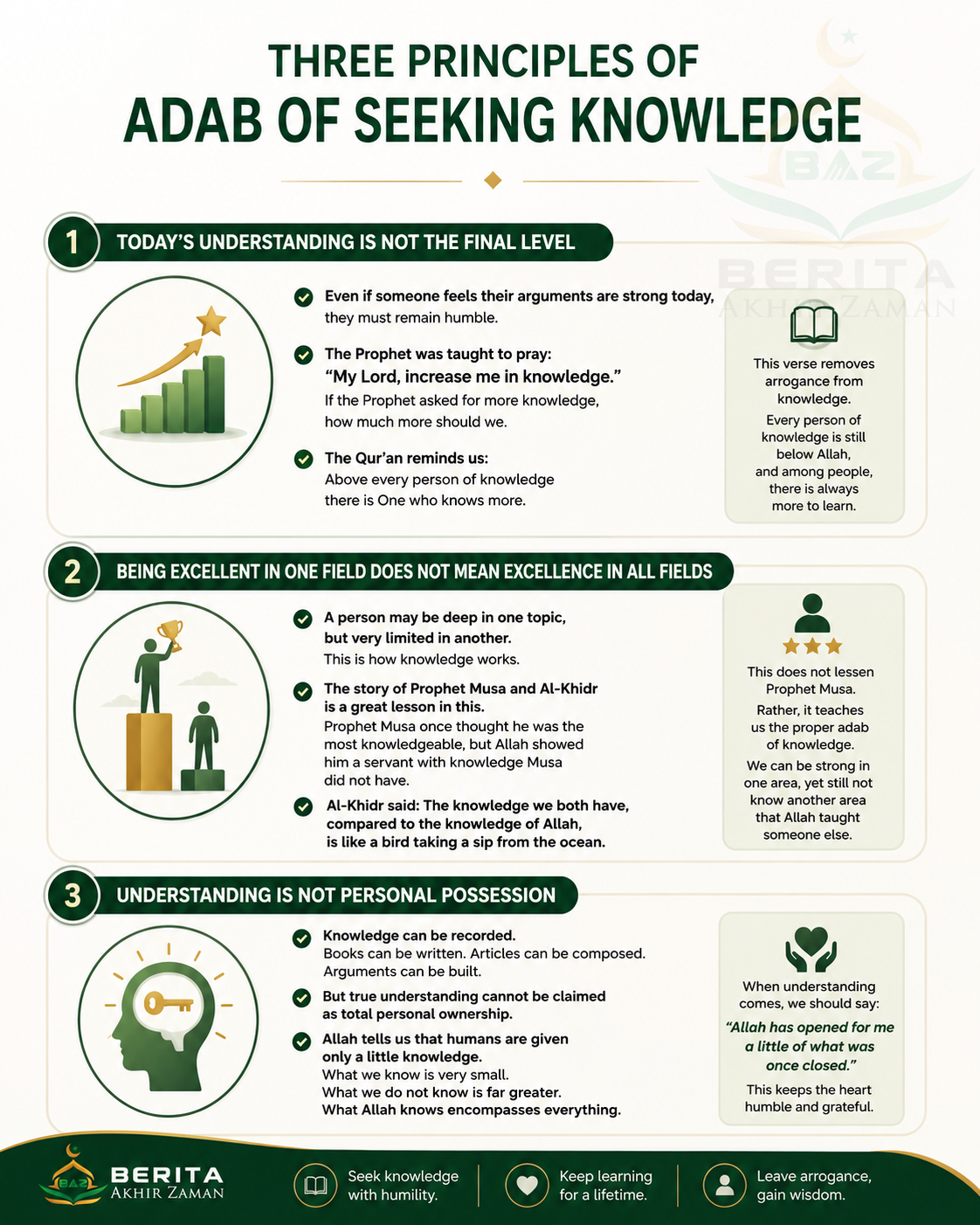
Therefore, a change in understanding is not strange. It is part of the journey of knowledge. What is wrong is when a person treats his understanding at one stage as the final closure to all possibilities of review and correction.
Conclusion
Knowledge requires effort. Experience requires life, observation and self-reflection. Understanding requires a gift from Allah.
We may read the same matter repeatedly, and Allah may open meanings that were previously unseen. We may think that we have reached the peak of understanding, only to later realise that what we thought was the peak was merely one step on a larger staircase. We may be strong in one subject, yet still ignorant in hundreds of other matters.
Therefore, the adab of a seeker of knowledge is to continue reading, continue reviewing, continue doing tadabbur, continue humbling the self and continue asking Allah:
رَّبِّ زِدْنِي عِلْمًا
My Lord, increase me in knowledge.
Experience must not be turned into a source of ruling that overrides revelation. Experience only helps us read situations, recognise our own weaknesses and see how the evidence of Allah operates in life. The measure of truth remains revelation, not personal experience.
Knowledge is sought.
Experience is reflected upon.
Understanding is granted by Allah.
Reply to: