

 English
 Bahasa Melayu
Melaka Is the Promised Land
Part 8: 14 Characteristics of Masyarikal Ardh
In Part 6 we learned about the creation of the heavens and the earth, and we saw that there is a specific portion of this earth that was given a special blessing from the very beginning of creation. Not every land on earth attains the rank of barokna, that is “the land which We have blessed.” This status is very limited and is only granted by Allah to certain selected regions.
In the Quran there are only four locations that are explicitly mentioned as barokna regions:
-
The land surrounding Masjid al Aqsa. See Surah Al Isra’ 17:1.
-
The land to which Allah brought Ibrahim and Luth. See Al Anbiya’ 21:71.
-
The land which Allah caused the Children of Israel to inherit in the east and west of the earth. See Al A‘raf 7:137.
-
The land that was the centre of the kingdom of Saba’ and its cities. See Saba’ 34:18 in the context of 34:15–19.
Most people view all these lands as separate and distinct locations scattered around the Arabian Peninsula. However, when these verses are pondered carefully in their context, together with the geographical structure and the repeated pattern of barokna that are mentioned again and again, we begin to see a very different picture.
I discovered that all of these locations which appear to be separate in fact point towards one and the same region, the region that most closely matches all of the characteristics of barokna described by Allah. However, I am not inviting you to believe me, and I am not demanding that anyone accept this conclusion.
What I am calling you to is this: return to pondering the Quran, because every single criterion used in this study is drawn from the verses of Allah themselves, not from my personal opinion. If you see what I see, that is a gift from the Lord for you. If you do not see it yet, that is fine. But before making any judgement, I ask that you examine the evidences from the Quran first, with an open heart.
Although it is difficult for me to state, after testing every characteristic of barokna that Allah sets in those four clusters of verses, characteristics that involve geography, the path of the sun, the nature of the land, the history of inheritance and the context of past and present communities, I am convinced that the region that is most accurate, most consistent and most aligned with all those characteristics is none other than the Malay Peninsula.
Reminder
Before we proceed, I would like to remind you that everything I write here is the result of tadabbur which is based on cross-checking the verses of the Quran, searching for context and making comparisons over a long period of time. This is not a new exegesis and it is not a personal opinion. There is only one method used, which is letting the Quran explain the Quran, without inserting ego or personal views.
If you agree, the best step is not to take my words, but to return to the verses that I have presented and ponder them yourselves. If you are unable to do so, bring them to your respective teachers and take their explanations instead, not merely my writing.
If you disagree, I ask that you be careful in expressing your views. The results of this tadabbur may not yet have been explored by you. It is feared that if what I have written is in fact the true meaning of the verses of the Quran, then without realising it you may have already rejected it, and even more dangerous if you mock it.
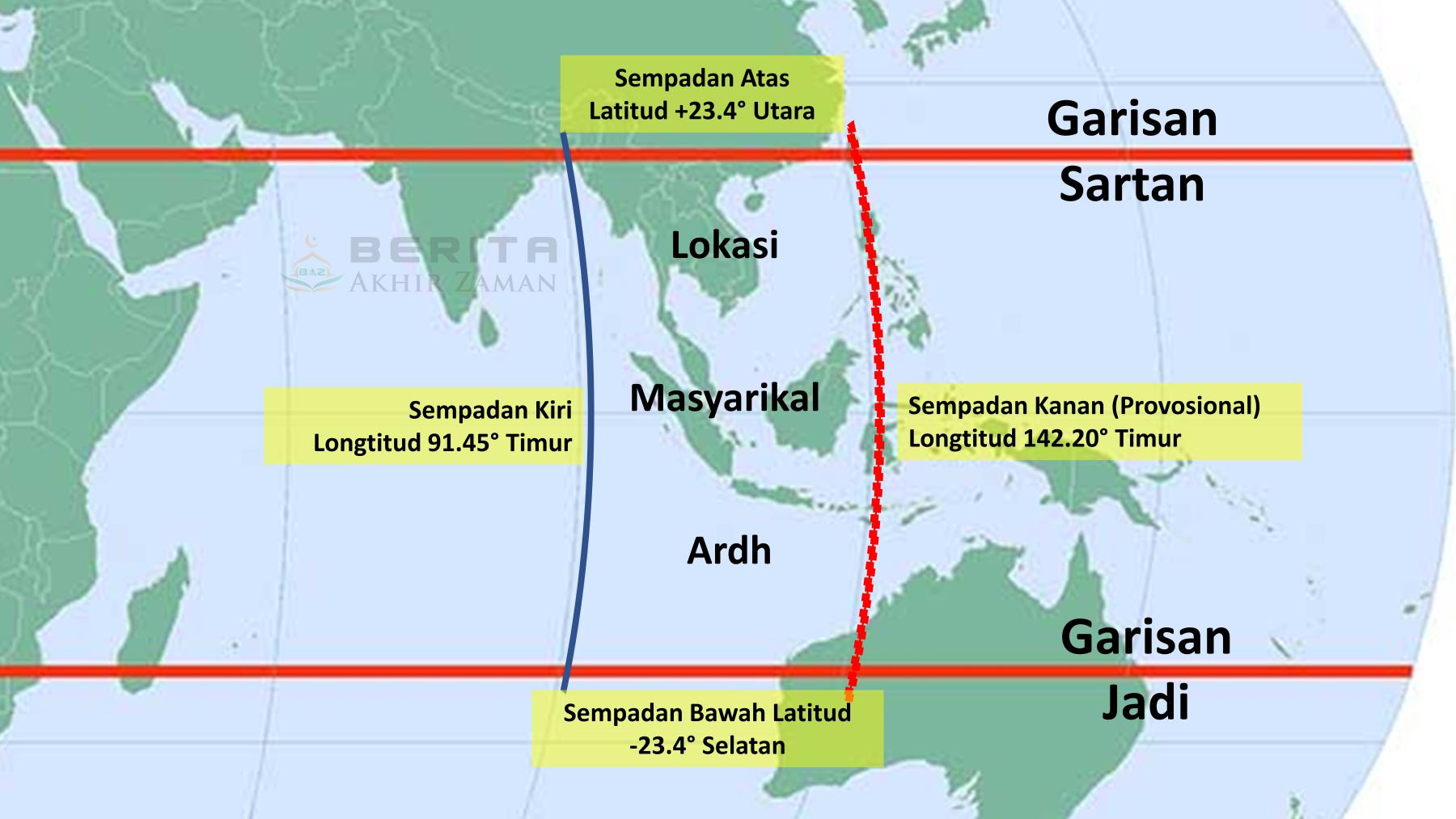
In Part 7 we locked down the location of Masyarikal Ardh which Allah granted to the Children of Israel through Prophet Musa. We determined that this region must be on the eastern side, within the band between the Tropic of Cancer (Sartan) and the Tropic of Capricorn (Jadi), as shown in the illustration above.
We also came to know that the left boundary of Masyarikal Ardh lies around Sandwip Island in Bangladesh. However, its right boundary has not yet been conclusively determined due to the lack of clear geographical data. Provisionally, I place it around the Mariana Trench.
The four barokna locations mentioned earlier, namely the land around Masjid al Aqsa, the land to which Allah commanded Ibrahim and Luth to go, the land inherited by the Children of Israel in the east and west of the earth, and the land that was the centre of the kingdom of Saba’, are all found within the same region in a general area called Masyarikal Ardh.
Purpose of This Part
The purpose of this part is to examine in greater depth the barokna locations mentioned in the Quran and confirm their positions based on tadabbur of the verses and the geographical structure we have built in the previous parts.
From the analysis carried out, the geographical characteristics of a region that qualifies as Masyarikal Ardh are as follows:
- The region must lie entirely to the east of Egypt, which is the central cluster where revelation was sent down and the commands of Allah were directed.
- Its upper boundary is the Tropic of Cancer (Sartan) at latitude +23.4° North.
- Its lower boundary is the Tropic of Capricorn (Jadi) at latitude –23.4° South.
- Its left boundary is Sandwip Island, Bangladesh, at longitude around 91.45° East.
- Its right boundary (provisional) is around the Mariana Trench, with Challenger Deep as a reference point at longitude approximately 142.20° East. This boundary is provisional, based on biogeographical divisions (the Wallace Line, Weber Line and Lydekker Line) that separate the Asian and Australasian blocks.
- The region must have more than two sunrise points, in line with the linguistic demand and contextual meaning of mashāriq.
- The region must consist of land, not open sea or areas without solid ground.
- The region must be inhabited, not empty or unfit for settlement.
- It must be a large landmass or a large island, not just a scattered chain of tiny islets.
- If it is an island, it must have a north–south distance of more than 29 km, which is the minimum distance needed to produce at least two sunrise points within the Sartan–Jadi band.
- The region must be able to accommodate the location of Masjid al Aqsa within the framework of blessedness described by Allah.
- The region must be able to accommodate the location of Ibrahim and Luth as mentioned in the barokna verses.
- The region must be able to accommodate the inheritance of the east and west of the earth for the Children of Israel as described in Surah Al A’raf 7:137.
- The region must be able to accommodate the centre of the kingdom of Saba’ and its surrounding towns, which is one of the barokna points that Allah describes as a land that has been blessed.
From the total of fourteen characteristics of Masyarikal Ardh that we have gathered from the verses of the Quran, most of them have already been explained in Part 6 and Part 7 through the analysis of the creation of the earth, the movement of the sun, the Sartan–Jadi band, and the initial positioning of the mashāriq region.
Part 8 is written specifically to explain those characteristics that have not yet been elaborated, particularly those requiring additional clarification such as the right boundary, the technical condition regarding sunrise points, the nature of land versus islands, the minimum north–south distance, and the requirement to accommodate the four barokna nodes that Allah mentions in the Quran.
I hope that you as readers, researchers and especially as people who ponder the Quran will be able to see how all these characteristics complement each other to form a coherent framework of Masyarikal Ardh.
Why Is the Mariana Trench Chosen as the Right Boundary (Provisional)?
The selection of the Mariana Trench as the right boundary of Masyarikal Ardh is a provisional research choice, not a final ruling. This trench is one of the deepest points on the planet and forms a major dividing line between land masses and very deep ocean systems. To its west lie the Nusantara archipelago and the Asian continental block. To its east the earth breaks into open ocean and smaller island chains which no longer meet the criteria of Ardh as a region inherited by the Children of Israel.
From an earth science perspective, biogeographers have long identified several dividing lines such as the Wallace Line, Weber Line and Lydekker Line which distinguish between the fauna and ecosystems of Asia and those of Australasia. These lines do not align exactly with the Mariana Trench, but they all point to the same reality: to the east of Nusantara there exists a kind of natural “wall” separating two major blocks of creation.
In this study the Mariana Trench is taken as the provisional right boundary because it marks the point at which the structure of the earth and the distribution of land begin to change drastically. Beyond this boundary, what remains is mainly deep ocean and small island chains. Such areas no longer match the nature of Ardh as a wide, inhabited region capable of supporting the network of mashāriq and maghārib that was granted to the Children of Israel. If, in the future, more accurate geographical data emerges, this boundary can be refined without changing the fundamental principles of the verses.
Why Must There Be More Than Two Sunrise Points?
The word mashāriq is the plural of mashriq and does not merely mean “the east.” It carries the meaning of “multiple places where the sun rises.” This means that the region which Allah describes as Masyarikal Ardh does not have only one line of sunrise. It must have a sufficiently wide horizon such that sunrise can be observed from several distinct zones throughout the year.
From a simple observational standpoint, the sun does not rise from the exact same point every day. It moves along the horizon between two main limits determined by the Tropic of Cancer and the Tropic of Capricorn. Hence, any region that lies between these two lines and has a broad horizon meets the meaning of mashāriq. A small island with only a short coastline, on the other hand, produces only a narrow sunrise zone. It does not fulfil the plural sense of mashāriq that Allah uses to describe the gift to the Children of Israel.
Why Must It Be Land, Not Empty Sea?
The word al-ardh in Arabic refers to the land upon which humans walk and dwell. In many verses it is linked to habitation, crops, civilisation and inheritance. The sea is not included in the meaning of al-ardh in the context of the inheritance of the Children of Israel. Therefore Masyarikal Ardh must consist of real landmass, not open sea or areas without solid ground.
Why Must It Be Inhabited and Suitable for Settlement?
Allah states that the oppressed people were “made to inherit” the regions of mashāriq and maghārib. Inheritance of this sort does not occur over dead land unfit for habitation. It takes place over regions suitable for life, agriculture, trade and the construction of civilisation. Allah also mentions that the Children of Israel inherited the buildings of Pharaoh. See the article “Did Pharaoh Have a Palace in Nusantara?”
Therefore any region that qualifies as Masyarikal Ardh must originally be suitable for human settlement, not a barren desert that could never be a civilisational centre nor a tiny, isolated island that cannot accommodate a large population.
Why Must It Be a Large Landmass or a Large Island?
When Allah uses the plural forms mashāriq and maghārib in the context of inheritance for the Children of Israel, it indicates a multi-layered system of sunrise and sunset horizons within a single, large region. A large landmass or large island can support networks of cities, trade routes, agricultural zones and centres of governance. Chains of small, isolated islets do not have that structural capacity.
Therefore in this study, very small islands are excluded early from the list of candidates for Masyarikal Ardh because they do not meet the functional inheritance described in the Quran.
How Was the 29 km Minimum Distance Determined?
The 29 km figure is not a magical number and it is not a value mentioned in the texts. It is a technical estimate for the minimum distance needed to differentiate between two sunrise zones on a single island located between Sartan and Jadi.
In brief, the circumference of the earth along a north–south line (a meridian) is about 40,075 km. Divided by 360 degrees, one degree of latitude corresponds to roughly 111 km. If we take about a quarter of a degree as a practical separator between two zones, that gives roughly 27 to 30 km. This study uses the midpoint that is easy to reference, namely 29 km.
Any island whose north–south distance is less than 29 km will be treated as a single horizon zone. Such an island cannot generate a meaningful variation of mashāriq. An island exceeding this distance, however, begins to show clear differences in sunrise position when measured over the year. With this method, researchers themselves can take a map, measure the north–south distance of any island and independently rule out candidate locations that do not meet this condition.
Important Note on Masjid al Aqsa
Here I am not denying the centrality of Palestine in Islamic history, nor am I rejecting what is commonly known about Masjid al Aqsa from the perspectives of sirah, fiqh and the history of the Ummah. What I am doing in this study is merely extracting data from the Quran, listing all the characteristics that must exist in any region that claims to fall within the scope of “allatī bāraknā fīhā” linked to al Aqsa.
Therefore when I state that Masyarikal Ardh must be able to accommodate the location of Masjid al Aqsa, this is not yet a declaration that Aqsa is moved to the east or anything of that sort. It simply establishes that any candidate region we test must be able to contain all Quranic data at once without contradiction.
As a reader, especially if you are a researcher, I ask you to suspend personal conclusions until the entire series has been read and examined thoroughly. My personal opinions will only be stated clearly after all the data of the Quran has been laid out together.
Quranic Evidence for Three Barokna Clusters
a) The location of Ibrahim and Luth
The Quran explicitly states that Allah saved Ibrahim and Luth to a blessed land:
“And We delivered him and Luth to the land which We had blessed for all peoples.”
(see Al Anbiya’ 21:71)
This verse is the basis for affirming that there is a specific region which Allah calls “al-ardh allati bāraknā fīhā” which was the destination of Ibrahim and Luth’s migration. In this study that region is treated as one of the barokna nodes that must be taken into account when mapping Masyarikal Ardh.
b) The inheritance of the east and west of the earth by the Children of Israel
In Surah Al A’raf Allah says:
“And We caused the people who had been oppressed to inherit the eastern parts of the land and the western parts thereof which We had blessed.”
(see Al A‘raf 7:137)
This is the verse that forms the basis for the term Masyarikal Ardh, because Allah combines mashāriq al-ard and maghāribahā with the phrase “allatī bāraknā fīhā.” Therefore any region claimed to be Masyarikal Ardh must match the structure of this verse in terms of geography, function of inheritance and comprehensive barokna qualities.
c) The centre of the kingdom of Saba’ and its network of cities
The Quran tells of the people of Saba’ who were granted a great favour through a network of towns and safe journeys:
“And We placed between them and the towns which We had blessed [many] visible towns, and We determined between them the journey…”
(see Saba’ 34:18, read with the context of 34:15–19)
In this verse “al-qurā allati bāraknā fīhā” refers to a chain of blessed towns that became trade destinations and waypoints for the people of Saba’. In this study the Saba’ node is treated as yet another point that must be able to be encompassed by Masyarikal Ardh, so that the barokna network in the Quran is not broken up into several unrelated blocks.
Conclusion
Part 8 is a detailed exposition of those characteristics of Masyarikal Ardh that have not yet been discussed in earlier parts. Here we have seen that every characteristic used to evaluate a region does not arise from human opinion, is not the product of mere geographical speculation and is not a cultural interpretation. All of them must emerge through disciplined tadabbur of the verses which Allah Himself has set out in the Quran.
We have seen how the four barokna clusters mentioned by Allah, namely the land around Masjid al Aqsa, the land of migration of Ibrahim and Luth, the land inherited by the Children of Israel in the east and west of the earth, and the blessed land of the kingdom of Saba’, must all be present within one grand framework which Allah names as mashāriq al-ard and maghāribahā. These are not scattered fragments of information, but directives that guide us towards a very specific geographical structure.
We have also seen that the conditions of Masyarikal Ardh cannot be invented and cannot be changed arbitrarily. They must match the position of the sun, the Sartan–Jadi horizon band, the nature of the land, the existence of inhabitants, the extent of the region, the biogeographical dividing lines, and the ability of the region to encompass the barokna nodes mentioned by Allah. When all these characteristics are arranged together, we find that there are not many regions on earth that can satisfy such strict criteria.
Yet I repeat once more for you: this entire discussion is not a call to believe me. I am not asking for loyalty to my opinion, because my opinion is not the goal. What I am calling you to is only this: return to the Quran. Examine the verses I have presented and ponder them yourselves with a sincere and honest heart. If you see what I see, that is a gift from Allah to you, a sign that Allah loves you, so be deeply grateful. If you do not see it yet, be patient and continue reading until this series is complete.
Although Part 8 concludes the detailed conditions of Masyarikal Ardh, our search is not over. There remains a much greater question awaiting us, namely: what exactly are the attributes of barokna that Allah intends in allatī bāraknā fīhā, and what are the characteristics of that land such that Allah elevates it as the centre of inheritance for earlier nations?
With the permission of Allah, in the next part we will delve more deeply into the meaning of barokna. There we will see how Allah Himself has placed signs, patterns and indicators that cannot be erased by human history nor deceived by Iblis and Dajjal.
Support for This Research
This writing is an exclusive study owned by BAZ on the website:
https://beritaakhirzaman.com
If you wish to continue supporting research and exclusive analyses like this, you may make a voluntary sponsorship at the following link:
https://member.beritaakhirzaman.com/sponsorship/create/pengurusan-dan-pembangunan-platform-baz
The reader support system is managed through member accounts on the BAZ website.
Member Login: https://member.beritaakhirzaman.com/login
Member Registration (Free): https://member.beritaakhirzaman.com/register
Reply to: