

 English
 Bahasa Melayu
Melaka Is the Promised Land
Part 6: Tracing The Blessed Land
We are now entering a phase where the scope of our search for the blessed land (barokna) must be narrowed down into the range of the region of Masyarikal Ardh. This study rests on the core event when the Children of Israel were granted a land in the region of the rising of the sun after they were freed from the oppression of Pharaoh in Egypt.
Part 9 is not a beginning but a continuation phase in this series. To make it easier for you to understand, it must be read together with Part 7 and Part 8. Without reading them, a reader will easily lose the thread because they will not see the full framework of the Quranic verses that guide us step by step towards the location of the blessed land.
Although this part is “just a reading”, in reality the burden lies on the intellect. We need to weigh carefully, review repeatedly and be prepared to make a decision. In the end we must choose whether to maintain old, inherited beliefs or move to a new position that is proposed through the examination of the Quranic verses in this writing.
This part is not mere information. It is a test of our readiness to accept that the Quran still opens doors to discoveries that are great and vast and also deep and far-reaching.
Review
As a review, our discussion is based on the command of Allah to the Children of Israel through Prophet Musa in the following verse:
وَأَوْرَثْنَا ٱلْقَوْمَ ٱلَّذِينَ كَانُوا۟ يُسْتَضْعَفُونَ مَشَـٰرِقَ ٱلْأَرْضِ وَمَغَـٰرِبَهَا ٱلَّتِى بَـٰرَكْنَا فِيهَا ۖ وَتَمَّتْ كَلِمَتُ رَبِّكَ ٱلْحُسْنَىٰ عَلَىٰ بَنِىٓ إِسْرَٰٓءِيلَ بِمَا صَبَرُوا۟ ۖ وَدَمَّرْنَا مَا كَانَ يَصْنَعُ فِرْعَوْنُ وَقَوْمُهُۥ وَمَا كَانُوا۟ يَعْرِشُونَ
“And We made the people who had been oppressed inherit the eastern parts of the land and its western parts, which We had blessed therein. And the fair Word of your Lord was fulfilled for the Children of Israel because they had been patient, and We destroyed what Pharaoh and his people had been making and what they had been building high.”
QS Al A‘raf 7:137
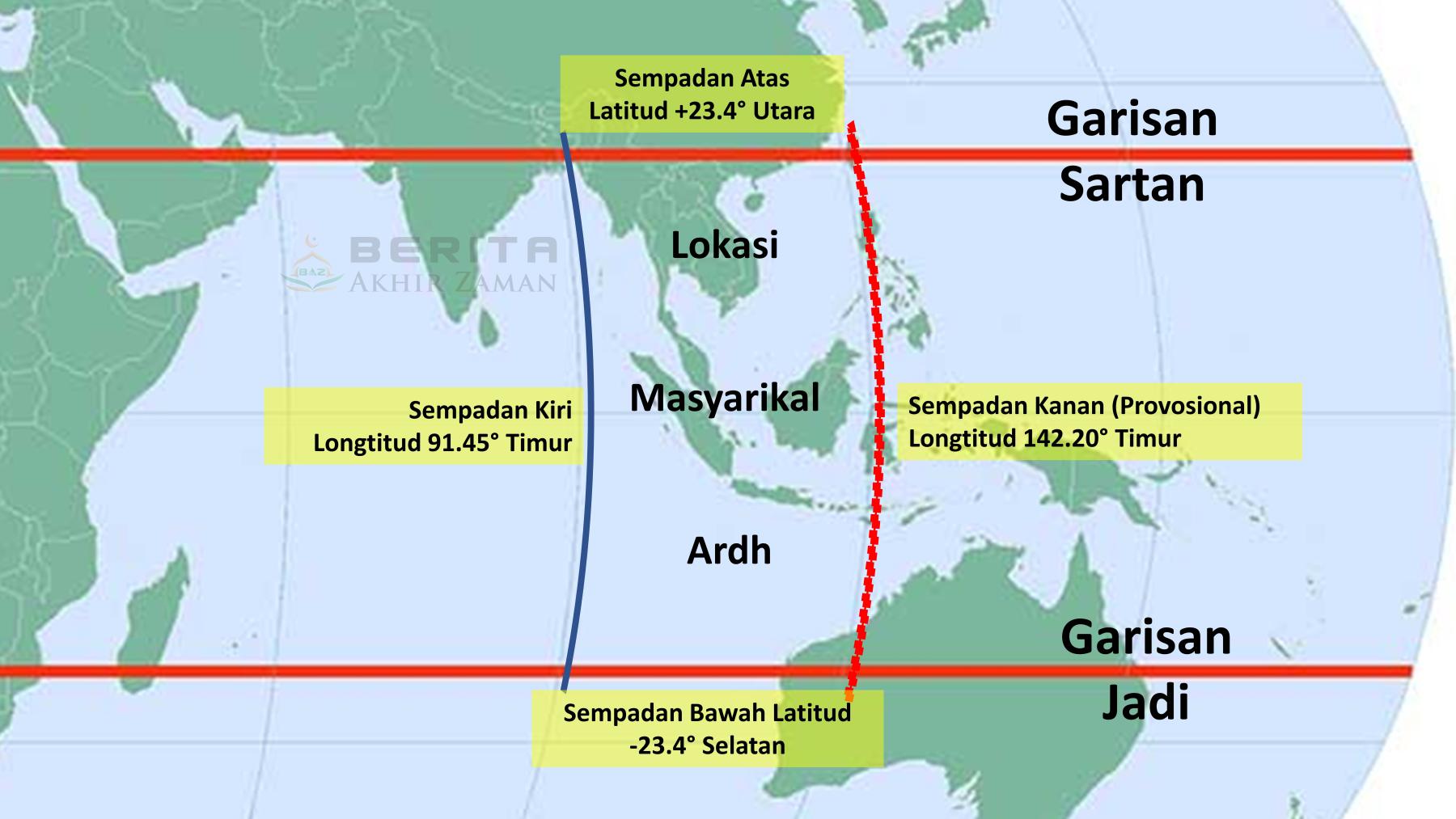
In the previous part we have completed the discussion on mashāriqa al-ardhi wa maghāribahā (مَشَـٰرِقَ ٱلْأَرْضِ وَمَغَـٰرِبَهَا) and we have determined the location of Masyarikal Ardh with 14 characteristics derived from the Quranic analysis, and this was shown in the following diagram:
In QS Al A‘raf 7:137, the phrase mashāriqa al-ardhi wa maghāribahā (مَشَـٰرِقَ ٱلْأَرْضِ وَمَغَـٰرِبَهَا) cannot be understood in isolation. It has been locked together with the phrase allatī bāraknā fīhā (ٱلَّتِى بَـٰرَكْنَا فِيهَا). This means that if we are seeking the location of mashāriqa al-ardh then we must search together with the attribute that Allah has locked to it, namely allatī bāraknā fīhā.
Since we have already identified mashāriqa al-ardh, it is only natural that in this writing we want to understand the meaning of allatī bāraknā fīhā so that we can find its location more precisely.
Support for the Study
This writing is an exclusive study belonging to BAZ on the website https://beritaakhirzaman.com. Click here to sponsor this exclusive research series. If you have not yet registered as a member in the system, register here. It is free. If you already have an account, you may log in here.
The Importance of Studying the Phrase Allatī Bāraknā Fīhā
We have presented and completed the discussion on mashāriqa al-ardh in Part 7 and Part 8. These two parts proved that the region of the places of sunrise is not a random theory but a very clear geographical zone in the Quran. We have determined its boundaries between the Tropic of Cancer (Garisan Sartan) and the Tropic of Capricorn (Garisan Jadi) as well as the eastern region stretching from Bengal to the Mariana Trench, as shown in the diagram above.
Once the region of mashāriqa al-ardh has been established, we now move to something more subtle and more important, namely the phrase اللَّتِي بَارَكْنَا فِيهَا. Many try to understand Masyarikal Ardh without first examining this phrase, and as a result they deviate into an interpretation based on direction instead of an interpretation based on land. The verses of Allah do not give room to such assumptions. To identify the blessed land, we must first understand what exact thing is being referred to by the word اللَّتِي, which means “which/that”, and the word فِيهَا, which means “in it”.
Our focus now is to understand this phrase before resuming the discussion on mashāriqa al-ardh. This is obligatory because this phrase is what determines what Allah means by “that which is blessed”. If this basic matter is not settled first, then we will not know what actually receives that blessing. Both اللَّتِي and فِيهَا cannot stand without a precise point of reference. If their reference is wrong or vague, then the entire verse becomes vague and the search for the location of the blessed land will never reach a correct conclusion based on the Quran.
Basic Understanding of the Phrase اللَّتِي and فِيهَا
In QS Al A‘raf 7:137, Allah uses two key words: اللَّتِي and فِيهَا. Both may seem small, but they have a very large impact in determining what Allah actually means by the blessed land.
The word اللَّتِي means “which/that”, but in the structure of the Arabic sentence this “which” is not a free-standing word. It must refer back to a specific thing that has already been mentioned before. The word فِيهَا means “in it” and this “it” can only refer to the same thing that is being referred to by “which/that”.
This means that these two words move together and point to the same object, not two different things, not a direction, not a collective, and not a broad region in the plural sense. In this verse, the only object that exists before that phrase is the earth or the land or ٱلْأَرْضِ, not the east and not the west.
Why the East and the West Cannot Be the Referent
Many people read this verse in haste and assume that the phrase “which We had blessed therein” refers to “the eastern part of the land” or “the western part of the land”. This happens because they align that phrase directly with the Malay translation and then assume that “which” refers to the directions east or west. However, in the Arabic language as I have understood it through years of tadabbur of the Quran, this is not allowed at all.
The word “east” in this verse appears in the plural form mashāriq, which means “places of sunrise”, not a single east. Likewise, “west” appears as maghārib, which means “places of sunset”, also not a single west. So both are collections of directions, wide directional zones and not objects with physical form.
A direction cannot possess an “inside” and cannot be used as the referent for the word “it”. It also cannot function as the pair to “which” in the structure of this sentence. Therefore, east and west are completely unfit to be the referents of اللَّتِي and فِيهَا because they are not a single object, not a single unit and not a single land.
Why اللَّتِي and فِيهَا Must Refer Back to Land
When we read the phrase اللَّتِي بَارَكْنَا فِيهَا, we are reading a very precise statement. Allah says “which We had blessed therein.” The words “which” and “therein” only make sense if they refer back to something that can actually have an “inside” and can carry the meaning of a single unit, not a direction that is virtual in nature.
Land can have an “inside”. Land can be a single entity. Land is also mentioned before this phrase. Therefore, logically, the word “which” can only refer back to the land that has been mentioned before, and “therein” must also refer back to “inside” that same land. This is what makes that land the blessed land. The eastern and western directions, which are plural, cannot bear this meaning because they are not concrete entities. They are not a single region and they do not have an “inside” that can act as a referent.
Thus the only correct choice linguistically is أَرْض, that is, the earth or land. Going forward our focus will be the land.
The Major Impact of the Error If اللَّتِي Is Placed on the East
I have examined many views over many years before presenting this conclusion. I see that this is the point where many people stumble. There are those who deliberately reject the rules of Arabic in order to force اللَّتِي to refer back to the east so that they can place India as “the west of Nusantara” and thereby change the entire geography indicated by the Quran. This is not a small mistake but a falsification of the meaning of the verse.
If we force “which/that” to refer back to the east, we are in fact forcing the word to refer to something that the Arabic language never allows it to refer to. This is not a matter of Quranic interpretation; it is a matter of language structure that cannot be altered. To change the referent of “which/that” is to change the structure of the sentence and falsify its true meaning.
Therefore, this does not mean that the east has no status in this verse. The east remains the large environment that Allah calls mashāriqa al-ardh. However what is crucial is that the phrase اللَّتِي بَارَكْنَا فِيهَا does not refer to the east itself. It refers to a specific land that lies within that eastern environment, within the Masyarikal Ardh that we have already locked. Thus it is a serious error if anyone assumes that the “blessed land” is the east as a direction. The Arabic of the verse never carries such a meaning.
Conclusion
In conclusion, the matter is very clear and Allah does not leave any room for manipulation in this verse. We have seen in the discussion of verse 7:137 above that Allah uses two interlocking words, اللَّتِي and فِيهَا. Both must refer to a single specific object and that object must be the land that was mentioned previously as الأَرْض.
The east and the west cannot be the referents because they are not a single object, they are in the plural form, they do not have an “inside” and they do not fulfil the structural conditions of this sentence. Therefore the phrase “which We had blessed therein” does not refer to the eastern or western directions but refers to a specific land within the environment of Masyarikal Ardh. This is the essential foundation that must be understood before we can identify that blessed land on the actual map of the world.
We have established that the phrase اللَّتِي فِيهَا refers to a specific land and not to the directions east or west. Now the time has come for us to study the word بَارَكْنَا (barokna) in more depth. At this stage we are no longer determining the broad geographical environment, because Masyarikal Ardh has already been locked through the four boundaries that were explained in Part 7 and Part 8.
What we are about to do now is zooming in. We go closer inside the region of Masyarikal Ardh to search for the specific location that Allah intends as the blessed land. The word barokna is very important in this process because it is not merely an inner, psychological or spiritual term. It carries technical value, real physical implications and deep historical consequences.
In general, the meaning of barokna refers to a blessing that is stable, growing and continuous. By understanding these characteristics of blessing, we can see important indicators that differentiate one area from another within the region of Masyarikal Ardh.
In the next section we will break down the meaning of barokna from the aspects of language, word form, the context of all verses that contain barokna and its connection with the real geographical features within Masyarikal Ardh. We have already understood the referents of “which” and “in it” as well as the true meaning of “We have blessed”. Once all this is clear, only then can we combine the entire network of Quranic indicators in order to trace the location of that blessed land precisely without missing the direction, insyaAllah.
Reply to: