

 English
 Bahasa Melayu
Series: Malaysia Is About to Be Attacked, Because This Is the Land of Bani Israel
From Melaka 1511 to Independence 1957: The Effects of the First Attack
Introduction
In the previous part, we established the 10 characteristics of the first attacker in Surah al-Isra’ verse 5. That article focused on who the attacker was, the nature of their strength and how they were able to enter into خِلَالَ الدِّيَارِ (khilāla ad-diyāri), meaning the spaces between, the inner passages and the deep layers of the lands, dwellings, settlements and living spaces.
This writing now moves into another phase. We are no longer asking who the first attacker was. Instead, we are asking:
What did they do after entering?
What became suspended because of their penetration?
What was lost from the Children of Israel until Surah al-Isra’ verse 6 speaks of the return of karrah, amwal, banin and nafir?
This is the function of this part. It serves as a connecting article between verse 5 and verse 6 of Surah al-Isra’. Verse 5 is about the penetration by the attacker, while verse 6 is about the restoration after the attacker has left.
Therefore, before you reach verse 6, you must first observe the major effects left behind by the first attacker. For that purpose, let us revisit verses 5 and 6.
Allah SWT says in Surah al-Isra’ verse 5:
فَإِذَا جَآءَ وَعْدُ أُولَىٰهُمَا بَعَثْنَا عَلَيْكُمْ عِبَادًا لَّنَآ أُو۟لِى بَأْسٍ شَدِيدٍ فَجَاسُوا۟ خِلَـٰلَ ٱلدِّيَارِ وَكَانَ وَعْدًا مَّفْعُولًا
So when the promise of the first of the two came, We raised against you servants belonging to Us, possessing severe might. Then they moved through the inner spaces of the dwellings. And it was a promise that was surely fulfilled.
Then Allah says in verse 6:
ثُمَّ رَدَدْنَا لَكُمُ ٱلْكَرَّةَ عَلَيْهِمْ وَأَمْدَدْنَـٰكُم بِأَمْوَٰلٍ وَبَنِينَ وَجَعَلْنَـٰكُمْ أَكْثَرَ نَفِيرًا
Then We returned to you the turn against them. We aided you with wealth and children. And We made you greater in terms of nafir.
Observe the sequence carefully. Verse 5 speaks of the attacker entering. Verse 6 speaks of something being returned. Therefore, the important question is this: what happened between the penetration in verse 5 and the return in verse 6?
The most important question we should ask is:
What had been lost or suspended before it was returned?
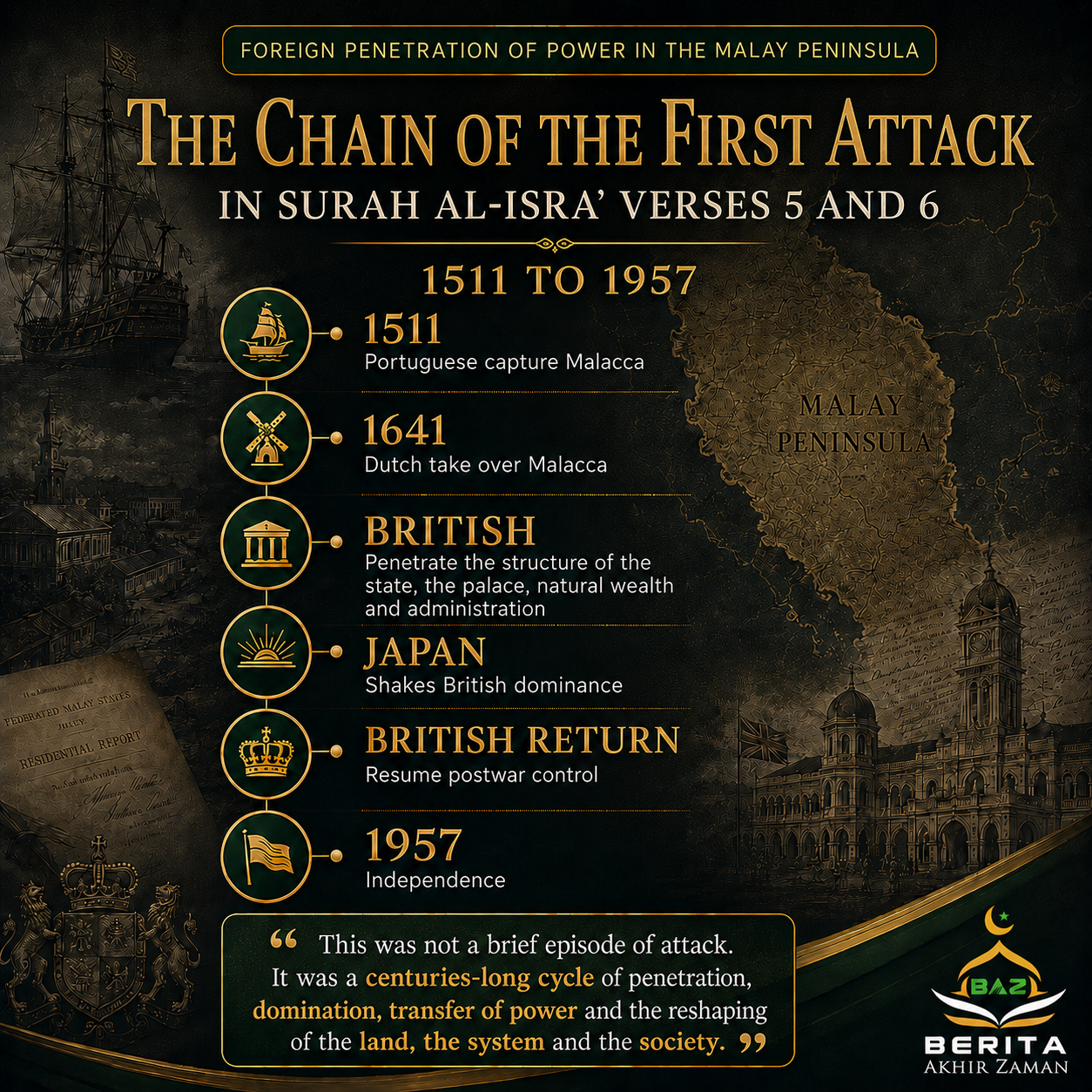
Within this research framework, the first attack is read as the cycle of Western imperialism over Nusantara, with a specific focus on the Malay Peninsula. It begins clearly with Melaka in 1511, moves through the Portuguese, the Dutch, the British, the Japanese occupation, the return of the British after the war and finally leads to Independence in 1957.
It is important to stress that this reading is built as a research framework, not as an absolute interpretation that closes off every other possibility. This article evaluates the compatibility between the structure of Qur’anic wording, the characteristics of the attacker in verse 5 and the historical effects of imperialism in the Malay Peninsula. You should read this argument as the construction of a layered analytical framework, not as a claim settled by a single verse or one historical event.
Required Reading Before Continuing This Article
Before continuing, you are required to read the foundational article below first:
Essential Foundations That Must Be Understood Before Reading This Article
This article must not be read in isolation from that foundation. Do not continue reading this article with a mind already filled with assumptions. Do not read it through an old framework that has become used to locking Surah al-Isra’ into interpretations that may not necessarily be placed correctly.
Focus on the Effects of the Attacker, Not the Profile of the Attacker
The profile of the first attacker has already been established through verse 5. They were not ordinary attackers. They were not merely a group that raided a national border. They were not merely enemies who came and left without leaving any effect.
The Qur’an describes them as:
عِبَادًا لَّنَآ
servants belonging to Us
However, the phrase عِبَادًا لَّنَآ does not mean that the attackers were necessarily righteous, pure or morally pleasing to Allah. All creatures are servants of Allah in the sense that they are subject to His power. In this verse, they are read as an instrument of punishment and a historical cause that Allah allowed to occur, not as proof that their oppression became good or justified.
They possessed:
بَأْسٍ شَدِيدٍ
severe might
They moved until:
فَجَاسُوا۟ خِلَـٰلَ ٱلدِّيَارِ
they moved through the inner spaces of the dwellings
This phrase is extremely important and we emphasize it again. Diyar does not only mean houses. It includes living spaces, territories, places of residence, social centres, centres of power, economic spaces, administrative structures and security arrangements.
Therefore, when the verse says that they entered into خِلَالَ الدِّيَارِ, it describes penetration into the inner layers. It was not merely an external attack, not merely an attack at the border and not merely a distant threat.
The first attacker in the verse entered into spaces that were supposed to be protected. They were able to move through the inner passages of social life. They penetrated the centres of power and government administration. They left such a major effect that verse 6 must be read as a plan of restoration after that penetration had taken place.
Therefore, it must be emphasized again that this writing is no longer building the profile of the attacker. If the reader is still unclear about the characteristics of the first attacker, they need to return to the previous parts. This article moves to the effects left behind after the attacker entered.
The focus of this part is the implication brought by the attacker after they entered into the diyar.
That effect involved five major matters:
First, sovereignty became suspended.
Second, the function of mulk became weakened.
Third, natural wealth was controlled.
Fourth, the administrative system changed.
Fifth, the demography of the land was rearranged.
From Military Attack to Layered Imperialism
I believe all of you know the history of colonization in the Malay Peninsula. It was not a story of a day or two. It was a story of centuries. It was not a short attack that ended after a single battle.
We have seen a layered cycle of imperialism passing from one power to another. Melaka fell to the Portuguese in 1511. That fall was not merely the loss of a port city, but the beginning of Western intervention into the most important trade route in Nusantara.
Melaka controlled the Strait of Melaka, which connected the Indian Ocean with the South China Sea. Historical sources state that the Portuguese controlled Melaka from 1511 to 1641 before the Dutch took over. During that period, Melaka functioned as a regional and international centre of trade.
The fall of Melaka in 1511 opened the door for Western imperialism to enter Nusantara because the Portuguese did not merely take a port city. They took a trade centre on the Strait of Melaka, a route connecting the worlds of India, Arabia, China and the Malay Archipelago.
The Portuguese came with weapons, ships, cannons and a maritime imperial network. They did not come as ordinary traders. They came to control the port, trade routes and strategic position.
After that, the Dutch took Melaka in 1641. Historical sources from the Melaka government mention that the Dutch and the Malays of Johor attacked Melaka until the Portuguese surrendered, after which the Dutch ruled Melaka for 154 years.
If the Portuguese and the Dutch largely focused on ports and trade, the British moved deeper into the structure of the Malay states. They did not merely control trade routes. They began touching administration, natural wealth, taxation, law and the economic direction of the Peninsula.
Then Japan came during the Second World War. Japan was not a Western power, but the Japanese occupation became a harsh insertion into the imperial cycle. Japan shook British dominance and proved that Western colonial power was not invincible. After Japan surrendered in 1945, the British returned through the British Military Administration before the Malayan Union was attempted in 1946.
In the structure of this article, Japan is not placed as a Western power and does not become the main centre of the first attacker profile. Japan is mentioned because its occupation became a major disruption within the British colonial cycle. It shook the British position, accelerated local political awareness and opened the way for postwar change. Therefore, Japan functions as an important insertion within the imperial cycle, not as the main core of Western imperialism that began with Melaka in 1511.
Eventually, the Malay Peninsula achieved independence on 31 August 1957. British law itself made provision for the establishment of the Federation of Malaya as an independent and sovereign state within the Commonwealth.
The broad historical outline can be seen in the following infographic:
The British as the Deepest Penetration into the Diyar
The Portuguese and the Dutch remain important because both opened and continued the cycle of Western imperialism in Melaka. The Portuguese captured Melaka as an entry point into the trade route of the Strait of Melaka, while the Dutch later took over the same strategic position. However, when we assess the level of penetration into خِلَالَ الدِّيَارِ (khilāla ad-diyāri), the British require greater attention because their form of control did not stop at the port, the trading city or the maritime position alone.
The British entry into the Malay Peninsula did not occur in a single step. Its early signs had already begun before 1824 through Penang and Singapore as trading bases and strategic stations in the Strait of Melaka. After the Anglo-Dutch Treaty of 1824, the British position in the Peninsula became clearer when Melaka passed into British hands and Penang, Melaka and Singapore were then united as the Straits Settlements in 1826. At this stage, the British were already strong along the coast, in the ports and along the trade routes.
However, British penetration into the structure of the Malay states became far clearer after the Pangkor Treaty of 1874. Here, the British no longer stood merely as a trading power outside the Malay states. They began entering the centre of decision-making through the Resident system. From that point, British influence touched the palace, administration, state revenue, taxation, law, economy, education and labour system. Therefore, in the context of خِلَالَ الدِّيَارِ, the post-1874 phase is more accurately read as the beginning of the deepest penetration into the political diyar of the Malay Peninsula.
Here, the Qur’anic phrase:
فَجَاسُوا۟ خِلَـٰلَ ٱلدِّيَارِ
they moved through the inner spaces of the dwellings
becomes highly important in this research framework. This phrase does not describe an enemy who merely attacks from outside or stops at the border. It describes penetration into a space that was supposed to be protected. In the context of the Malay Peninsula, the British did not merely stand as a trading power at the ports. They entered the structure of the states, drew close to the palace, controlled revenue and influenced administration.
One important point in this process was the Pangkor Treaty of 1874. This treaty opened the way for the British Resident system in Perak and later became a model for British intervention in other Malay states. Through this system, the Sultan remained as ruler. The palace still existed. Matters of Islam and Malay custom still remained under the position of the ruler. However, in matters of state administration, revenue, taxation and general policy, the British Resident appeared as an adviser whose advice had to be followed.
This is where the form of penetration becomes extremely subtle. The British did not need to remove the ruler in order to weaken royal power. They did not need to demolish the palace in order to enter the centre of palace decision-making. They also did not need to erase the name of the Malay state in order to change its direction. It was enough to place a Resident beside the ruler and turn his advice into a binding force in administrative matters. In that way, the ruler still appeared as the sovereign, but the operational power of the government began moving according to colonial will.
Therefore, the question is not whether the ruler still existed or not. The ruler did exist. The real question is how far the ruler remained free to determine the direction of the state when revenue, administration, taxation and development policy were under British influence. Here, we can see that sovereignty is not necessarily lost only when a throne is abolished. Sovereignty can also become suspended when decision-making power is transferred from the original ruler to an external power standing behind the administrative system.
This is a form of imperialism deeper than ordinary conquest. It was not merely conquest by sword, cannon or warship. It was also conquest through treaties, binding advice, revenue control, the organization of law and the restructuring of state administration. The army might not always be at the palace gate, but the colonial officer was inside the centre of decision-making. Cannons might not be fired every day, but economic and administrative directives continued to move according to the interests of a foreign power.
Therefore, in the context of Surah al-Isra’ verse 5, the British provide a very clear example of a power entering into خِلَالَ الدِّيَارِ. They did not merely seize the outer space. They entered the great political house of the Malay Peninsula. From inside that great house, natural wealth was organized, taxes were controlled, administration was changed, laws were shaped and the position of the Malay rulers was placed within a new framework that was no longer as free as before.
This does not mean that the phrase خِلَالَ الدِّيَارِ can only occur in the form of British colonization. What is meant here is that the British pattern in the Malay Peninsula provides a very strong historical example of penetration into the diyar, namely entry into centres of power, wealth, administration and the structure of life. The Qur’anic wording remains broader than one historical example, but this example shows how that meaning can be observed in the field of the Malay Peninsula.
This section is important before we enter Surah al-Isra’ verse 6. When Allah mentions that الْكَرَّةَ is returned, we need to ask what had become suspended. In this reading, what became suspended was not merely land or ports. What became suspended was the function of sovereignty. The ruler still existed, but operational power had been penetrated. The state still bore the name of a Malay state, but the direction of administration moved under colonial grip. Natural wealth remained in the land, but its use was directed toward the interests of the empire. This is the effect of penetration that must be seen before verse 6 is read as a verse of restoration.
Mulk Did Not Disappear in Name, But It Lost Operational Power
In understanding the effect of British imperialism in the Malay Peninsula, we need to distinguish between the existence of sovereign symbols and the actual function of sovereignty. British colonization did not take the form of abolishing all Malay rulers or dissolving the entire institution of the palace. The Malay rulers still existed. The palaces still stood. Royal titles were still used. Malay custom was still tied to the position of the ruler. Islam also remained within the domain of royal authority. Outwardly, the symbol of sovereignty did not disappear completely.
However, the more important question is the function of power itself. Was the ruler still free to determine the administration of the state? Did natural wealth, taxation, law, economic policy and the direction of state development still move fully according to the will of local sovereignty? Here, we need to see that sovereignty is not necessarily lost only when a throne is abolished. Sovereignty can also become suspended when operational power is transferred to an external party, even if the name of the ruler and the palace are still preserved.
The most accurate expression for this condition is:
Mulk did not disappear in name, but mulk lost its operational power.
This expression is not intended to diminish the position of the Malay rulers. Rather, it distinguishes between the symbolic position that still existed and the administrative space of power that had been limited by the colonial system. In the context of colonization, the ruler still possessed customary, religious and symbolic authority over the state, but operational power in matters of administration, revenue and general policy had been influenced by the structure of the British Resident system.
To understand this meaning within the Qur’anic framework, we need to return to Surah al-Ma’idah verse 20. In that verse, Prophet Musa AS said to his people, the Children of Israel:
وَجَعَلَكُم مُّلُوكًا
And He made you muluk.
At this stage, the relationship being built is a functional and structural relationship, not a genealogical claim being decided directly in this chapter. The verse from Surah al-Ma’idah is used to show that mulk in the story of the Children of Israel is tied to land, trust and sovereignty. Genealogical links, if they are to be discussed, require a separate discussion. This chapter only assesses how the concept of mulk and sovereignty can become suspended when a foreign power enters the centre of state decision-making.
Then the next verse says:
يَـٰقَوْمِ ٱدْخُلُوا۟ ٱلْأَرْضَ ٱلْمُقَدَّسَةَ ٱلَّتِى كَتَبَ ٱللَّهُ لَكُمْ
O my people, enter the sacred land that Allah has decreed for you.
The arrangement of these two verses is important because the phrase مُّلُوكًا (mulūkan) is mentioned before the command to enter the land that Allah had decreed for them. This shows that mulk does not stand as a position separate from land, trust and sovereignty. It appears in the story of the Children of Israel after they came out of the oppression of Pharaoh and before they were commanded to enter the land decreed for them. This shows that mulk is not merely a spiritual title or an abstract honour. It is tied to land, trust, sovereignty, freedom from oppression and the ability to manage life in the territory decreed by Allah. Within this framework, mulk is not a right that moves outside the permission of Allah. It can be given, withheld and returned according to His decree.
In other words, mulk in this framework does not merely mean that someone possesses the title of king. It refers to the ability of a people or a leadership to manage land, care for society, determine administrative direction, control resources, fulfil trust and no longer live under the compulsion of a foreign power. Therefore, when an external power enters and controls administration, natural wealth, taxation, law and state decisions, the function of mulk has already been disturbed even if its name still appears.
This is the form that can be seen clearly in British colonization of the Malay Peninsula. The ruler remained the ruler, but the British Resident became the power influencing administrative operations. The ruler remained in the palace, but the general administration of the state moved under colonial influence. The ruler remained the symbol of the state, but state revenue, law, economic policy and development direction were largely determined according to British interests. This was not merely an ordinary administrative change. It shows the function of sovereignty being suspended by an external power.
From this angle, British colonization was more subtle than conquest that openly removed a ruler. If the ruler were removed, the loss of power would be easy to see. But when the ruler was preserved while decision-making power was transferred to a colonial adviser, the loss became more hidden. The symbol of sovereignty remained, but the force of governance had been restricted. The name of the state remained, but the direction of the state moved within the framework of imperial interests. The land was still there, but matters of land, revenue and administration were no longer free from external grip.
Here, Surah al-Isra’ verse 6 becomes important when Allah says:
ثُمَّ رَدَدْنَا لَكُمُ ٱلْكَرَّةَ عَلَيْهِمْ
Then We returned to you the turn against them.
The word رَدَدْنَا (radadnā) carries the meaning of “We returned.” Allah does not use a wording that only indicates a new giving. Instead, this wording shows that something had once been with them, then became disturbed, withheld, suspended or lost from its original function, before being returned to them.
In the context of the Malay Peninsula, the more accurate statement is not that the Malay rulers disappeared completely. The more accurate statement is that the operational power of the rulers and the states became suspended within the imperial system. The ruler did not disappear in name, but the freedom of ruling power had been penetrated. The state did not disappear in name, but its centre of decision-making had been influenced. Natural wealth did not disappear from the land, but its benefit and direction of use were controlled by colonial interests.
Therefore, when the colonizer finally left, what returned was not merely a flag or an independence ceremony. What returned was الْكَرَّةَ (al-karrata), meaning the turn of power after the period of penetration ended. What returned was the ability to manage the land themselves after centuries of foreign power entering into the diyar. What returned was the function of sovereignty that had once been suspended, even though the form of government after independence was no longer entirely the same as the older form before imperialism.
With this reading, verse 6 cannot be understood only as a verse about victory in a general sense. It is deeper than that. This verse opens space to see how a people or a land can pass through a phase of losing the function of sovereignty and then receive again the turn of power after the period of foreign domination ends. Within this framework, the relationship between mulk, karrah and the history of imperialism in the Malay Peninsula must be read with greater care.
Amwal: The Natural Wealth Controlled by Imperialism
Surah al-Isra’ verse 6 does not only mention the return of الْكَرَّةَ (al-karrata), which is the turn of power returning after the period of penetration. The verse continues with another very important element:
وَأَمْدَدْنَـٰكُم بِأَمْوَٰلٍ
and We aided you with wealth.
The word أَمْوَٰلٍ (amwālin) must not be read as a minor addition in this verse. It is mentioned after الْكَرَّةَ, after the return of the turn of power. This arrangement signals that restoration after the penetration of the first attacker did not occur only at the political or military level, but also at the level of wealth, resources and economic strength.
Therefore, when verse 6 mentions that Allah aided them with أَمْوَٰلٍ, we need to ask an important question. What form of wealth had been affected, controlled or redirected in its benefits throughout the period of the first attacker’s penetration? In the context of the Malay Peninsula, the answer cannot be separated from natural wealth, tin, rubber, ports, trade, taxation, plantation land, labour systems and colonial export networks.
British imperialism in Malaya did not only touch the palace and administration. It also entered the economic structure of this land. The British were not merely present as a political power advising the Malay rulers. They built a system that made the natural wealth of the Malay Peninsula part of the interests of the empire. Tin and rubber were not merely local commodities. Both became the backbone of the colonial economy and a major source of profit for foreign capitalists and companies.
For that reason, when we speak about British penetration into خِلَالَ الدِّيَارِ (khilāla ad-diyāri), we cannot limit it to the palace and administrative offices. That penetration also occurred into the wealth of the earth, plantations, mines, ports, taxation systems and export structures. The Malay Peninsula was not only controlled on the political surface. The wealth inside the land and upon the land was also inserted into the network of imperial economy.
Economic History Malaysia states that in 1957, foreign interests, especially British and European interests, owned 62 percent of share capital in limited companies. Foreign interests were also highly dominant in the ownership of agricultural plantations and mining. This shows that even on the eve of independence, the Malayan economy still carried strong effects from the colonial structure of ownership. Rubber and tin were also described as among the most profitable industries, with ownership and control largely in the hands of British and European businesses.
More substantially, in 1919 Malayan rubber exports and Malayan tin production each contributed more than half of the world total for those two commodities. The profits from these two industries were so large that Malaya was called the dollar arsenal of the Empire. This expression alone is enough to show that the Malay Peninsula was not merely a territory administered by the British, but an economic field that supplied financial strength to the British Empire.
This means British imperialism did not only take political space. It took the produce of the land. It did not only enter the Malay states. It entered mines, plantations, ports, revenue offices and international trade networks. It did not only control the palace through the Resident. It also controlled the economy that fed the empire. Here, the meaning of أَمْوَٰلٍ (amwālin) in verse 6 becomes very important when read after verse 5.
When sovereignty became suspended, wealth also did not move freely for the benefit of the people and the land itself. Natural wealth remained in the Malay Peninsula, but its greater benefit was redirected through the colonial system. Taxes, exports, company ownership, mines, plantations and ports were organized according to external interests. Therefore, wealth did not physically disappear from the land, but control over that wealth had shifted to the network of imperial power.
This is why verse 6 needs to be read carefully. When Allah says:
بِأَمْوَٰلٍ
with wealth
it is not merely an image of them becoming rich again. Within this research framework, it can be read as the restoration of one component of sovereignty that had been controlled by the attacker. After the period of penetration, Allah mentions wealth as an element of aid. This shows that restoration after the first attacker was not only about political power returning, but also about material strength becoming the foundation of life for a people and a land.
With this reading, amwal is an element of economic sovereignty. It includes natural wealth, ownership of resources, the ability to manage the wealth of the land, control of taxation, trade networks and economic benefits that should return to the land and its people. During imperialism, these elements were under colonial grip. When sovereignty returned, wealth became one of the most important fields of restoration after الْكَرَّةَ was returned.
The arrangement of verse 6 is therefore very subtle. Allah mentions الْكَرَّةَ first, then He mentions أَمْوَٰلٍ. The turn of power must return before wealth can truly become an instrument of restoration. Without karrah, wealth can easily be controlled by outsiders. Without sovereignty, natural wealth can remain on one’s own land while its benefits move to a foreign empire. For that reason, in the context of the Malay Peninsula, British control over tin, rubber, taxation, ports and export structures needs to be read as part of the effect of penetration in verse 5 before verse 6 is understood as a verse of restoration.
In summary, أَمْوَٰلٍ (amwālin) in verse 6 opens a major layer in this study. This land once possessed local sovereignty, governing structures, natural wealth, trade routes and great resources. The wealth meant here is not necessarily the wealth of a modern state measured by GDP, central banks or a national economy as understood today. What is meant is wealth in the form of strategic position, trade routes, natural resources, ports, taxation, land, mines, plantations and the ability to manage resources. Therefore, the main issue is not simply whether a land was rich or poor, but who controlled the benefits of that wealth.
Then the function of sovereignty became suspended during the period of imperialism. Natural wealth remained in this land, but its benefits and control were largely redirected to the network of colonial power. Therefore, when the period of penetration ended, Surah al-Isra’ verse 6 opens space to see how الْكَرَّةَ (al-karrata) was returned and أَمْوَٰلٍ (amwālin) was mentioned as one of the elements of restoration after sovereignty returned.
Taxation, Administration and the New System Left by the Colonizer
The effect of the first attacker did not stop at the control of natural wealth. Imperialism did not only take the wealth of the land, control mines, collect taxes or control ports. The longer effect was the formation of a system. This is among the most complicated legacies of colonization because a foreign power can leave physically, yet the system it built can remain and become part of the structure of government afterward.
A city can be abandoned. Troops can return home. A governor can be replaced. But laws, departments, taxation systems, administrative frameworks, education, finance, land systems, civil service and constitutional frameworks built during the colonial period can continue to function after the colonizer no longer rules directly. This is the deeper nature of imperialism. It did not only conquer the land in its own time, but also shaped how that land would be managed after its time had passed.
In the context of the Malay Peninsula, the British left a major effect on the arrangement of modern administration. They organized offices, departments, land records, revenue systems, taxation, law, education, civil service and governing frameworks that later became part of the form of the modern state. During colonization, these structures functioned as instruments of colonial control. They helped the British manage the states, collect revenue, control the economy and determine policy. Yet after independence, part of the same structure was taken over, modified and used as the framework of local governance.
Here, we need to look at history carefully. The colonizer entered to dominate, but when the colonizer left, some of the instruments of domination did not simply disappear. They changed function. What had once been used to control the state for the interests of a foreign power later became part of the state’s own tools for administering its land.
This does not mean that colonization became good or worthy of praise. What is being discussed is a change in historical function. Structures that emerged during colonization could begin as instruments of control, then be taken over and adapted after independence. Moral assessment of colonization remains separate from analysis of the systems it left behind. This change does not mean that colonization was good. It only shows that the effects of imperialism did not end with the departure of the colonizer. Those effects continued to live in systems, administrative language, law, institutions and the way the modern state was organized.
In this connection, Surah al-Isra’ verse 6 needs to be read with even greater care. The verse does not say that everything returned to the old form absolutely. Allah does not say that every structure that existed before penetration would be restored in its original form. Instead, the verse says:
ثُمَّ رَدَدْنَا لَكُمُ ٱلْكَرَّةَ عَلَيْهِمْ
Then We returned to you the turn against them.
The wording used is الْكَرَّةَ (al-karrata), meaning a returning turn, a recurring round or the ability to overcome again those who had once dominated. Therefore, karrah does not necessarily mean that all old forms of government returned one hundred percent as they had been before the penetration occurred. It is more accurately read as the return of the turn of power after a period of foreign domination. In other words, what returned was the ability to manage the land themselves, not necessarily every old form without historical change.
For that reason, after Independence in 1957, the Malay Peninsula did not return to the old form of government as it had existed before the Portuguese, the Dutch and the British. Sovereignty returned, but its form appeared within the structure of a modern state. The Malay rulers remained part of the state structure. At the same time, the Westminster system, Parliament, the Constitution, federal government, administrative departments and the modern legal system became the framework of governance. The Yang di-Pertuan Agong became the Supreme Head of State. Parliament became the legislative institution. Government power was organized through the executive, judicial and legislative branches.
This shows that after imperialism, sovereignty did not return in a state empty of historical effects. It returned in a form that had passed through a long process of penetration, domination, transfer of power and restructuring of systems. The Malay rulers remained within the state structure, but the form of their power was no longer the same as before colonialism. The states still existed, but they were situated within the federal framework. Local governance returned, but it moved through a constitution and modern institutions born out of the long history of colonization and the process of independence.
Therefore, verse 6 should not be read as the absolute return of the old form. It is more strongly read as the return of the turn of power after the function of sovereignty had once become suspended. This is the important difference between “the old form returning” and “karrah being returned.” The old form may change. The system may carry the marks of colonial history. Yet the turn of power was no longer with the colonizer. Foreign power no longer ruled directly. The land returned to being administered by a local structure that emerged after a long period of imperialism.
Within this research framework, this becomes an important bridge before we enter Surah al-Isra’ verse 6. If verse 5 shows penetration into خِلَالَ الدِّيَارِ (khilāla ad-diyāri), then the effect of that penetration was not only on wealth and sovereignty, but also on the system that was left behind. After the attacker left, the land did not return to an original state empty of historical effects. Instead, sovereignty returned in a new form carrying the long marks of colonization, colonial administration and the formation of a modern state.
Thus, karrah in verse 6 can be understood as the restoration of the turn of power, not the return of the entire old form. This is what happened in the history of the Malay Peninsula. Sovereignty returned, but the system of government that emerged after Independence in 1957 was a combination of royal heritage, modern constitution, parliamentary system and administrative institutions that had passed through a long process of imperialism. That long history left its marks, yet the turn of power had shifted back from the colonizer to the land that had once been penetrated.
Banin and Nafir: The Demography Shaped by Imperialism
Surah al-Isra’ verse 6 does not only mention the return of الْكَرَّةَ (al-karrata) and aid through أَمْوَٰلٍ (amwālin). After mentioning power and wealth, the verse moves to the human element. This is extremely important because a land is not built only by systems, natural wealth and government. A land is also shaped by the people who live upon it, grow within it, work for it and eventually become part of its social and political arrangement.
Allah SWT says:
وَبَنِينَ
wa-banīna
and children
Then the verse continues:
وَجَعَلْنَـٰكُمْ أَكْثَرَ نَفِيرًا
wa-jaʿalnākum akthara nafīran
and We made you greater in terms of nafir.
These two expressions are not the same. Banin is related to offspring, lineage, generations and continuity of bloodline. It touches on children and the continuation of a people through time. Nafir, on the other hand, has a wider field. It relates to a group of people who can rise, move, be mobilized, respond to a call and form collective strength. In other words, banin explains the continuity of lineage, while nafir explains the human capacity that can form social, economic, administrative and national strength.
Within the framework of the Malay Peninsula, these two expressions open a very large field of observation. British imperialism did not only bring administrative systems, law, taxation and the colonial economy. Imperialism also brought people in large numbers. Indians, especially from South India, were brought in to work on rubber estates. Chinese migrants entered in large numbers into mining, trade and economic towns. This process was not merely an ordinary movement of labour. It reshaped the demography of the Malay Peninsula and left effects that continued to be felt after the colonizer left.
It must be stressed that when this article says people were brought in through the colonial system, it does not mean placing historical blame on Chinese or Indian communities as ordinary human beings. Many of them came as labourers, traders, workers and families who were also under pressure within the colonial economic system. What is being criticized here is the structure of imperialism that organized people according to the economic interests of the colonizer, not the existence of any community as part of post-independence society.
Here, Malaysian readers need to observe this matter more carefully. Malaysia today is not shaped only by the Malays as the political original inhabitants of this land. Malaysia is also shaped by the presence of Chinese and Indian communities that became part of the social, economic and national structure after a long historical process. A large part of that demographic change occurred during the period of British imperialism. Therefore, when we read verse 6, which mentions banin and nafir, we cannot see people merely as population numbers. We need to see how people became a component of restoration after the penetration of the first attacker.
In colonial history, the British organized people according to economic function. Some worked in mines. Some worked on estates. Some lived in trading towns. Some entered systems of service, education, administration and economic networks. The effect of this arrangement was enormous. Imperialism did not only take natural wealth. It also organized people upon the land. It did not only build a colonial economy. It formed a colonial society divided according to work, settlement, education, language and economic function.
After the colonizer left, the people brought into this land did not disappear. They remained. They produced descendants. They built lives. They became part of society. They entered the major discussion about citizenship, rights, responsibilities, language, religion, the position of the rulers, the position of the Malays and the formation of an independent state. This is where the arrangement often called the social contract within modern Malaysia emerged. The issue was not only who lived in this land, but how all the people gathered by colonial history were to be reorganized within an independent state. The principle of citizenship, including the debate around jus soli, became part of this major process.
One of the biggest issues in this process was the principle of citizenship based on birth in this land, often called jus soli. In the proposal for the Malayan Union, this principle became highly sensitive because it was seen as opening citizenship too widely to non-Malay residents without a sufficiently strong bond to the original sovereignty of the land, the position of the Malay rulers and the structure of the Malay states. Opposition to the Malayan Union should not be read only as rejection of other communities. It must also be read as rejection of the colonial method of rearranging land, people and sovereignty as though everything could be determined through a British administrative framework.
Therefore, this discussion is not intended to deny the citizenship of any community that has become part of this country through the arrangement of independence. The issue is how citizenship, the position of the Malay rulers, Islam, the Malay language and certain rights were reorganized after the demography of this land changed through the colonial period. In that sense, the social contract is not read as a tool to reject the existence of others, but as an effort to reorganize nafir within an independent state.
However, after a long political process, the question of citizenship still had to be resolved because the human reality on this land had changed. Chinese and Indian communities who came through the colonial cycle did not disappear after the British left. They had become part of the human arrangement in the Malay Peninsula. Therefore, the formation of an independent state required a new arrangement that recognized citizenship while at the same time preserving the position of the Malay rulers, Islam, the Malay language and certain rights tied to the original sovereignty of this land. Here, Malaysia’s social contract can be read as an effort to reorganize nafir after a long period of imperialism.
Therefore, the issue of banin and nafir is not small. It touches the foundation of Malaysian society. Malays, Chinese and Indians cannot read this history separately. Malays see how sovereignty, rulers, land and natural wealth were once penetrated by foreign power. Chinese and Indians can also see that their presence in this land did not occur randomly in history. It entered into a larger arrangement that eventually formed society, labour, economy and the capacity of the nation after the colonizer left.
Within the larger research framework, the writer has a separate discussion regarding the connection of some Indian and Chinese groups to branches of the Children of Israel. It must be emphasized that this statement is not a universal claim about all Chinese or all Indians. It is also not a claim of ethnic superiority or nobility of blood. The discussion of lineage, migration and ancestral branches requires a separate and more detailed study. In this article, the matter is only mentioned as a research premise that has not yet been opened, while the main focus of this chapter is demographic change and the increase of human capacity within the meaning of nafir.
This article itself does not discuss that evidence in detail because it requires its own space. For this section, however, it is enough for us to see one matter first. Surah al-Isra’ verse 6 speaks of restoration after penetration not only through power and wealth, but also through people. Therefore, the demographic change of the Malay Peninsula during the period of imperialism cannot be treated as a side event. It is part of the major effect of the first attacker that must be observed before verse 6 is fully understood.
If amwal is material strength, then banin and nafir are human strength. Without people, mines do not move. Without people, estates do not live. Without people, ports do not function. Without people, administration does not run. Without people, a country does not have the capacity to rise after the colonizer leaves. Therefore, when verse 6 mentions أَكْثَرَ نَفِيرًا (akthara nafīran), it opens space to understand how an increase in people becomes part of collective strength after the period of penetration.
This also helps us see Malaysia’s social contract more deeply. It is not merely a modern political compromise. It was born from historical conditions shaped by imperialism. The British brought in people for the interests of the colonial economy, but after imperialism ended, the people living on this land had to be reorganized within an independent state. Here occurred the meeting between Malay sovereign heritage, the institution of the rulers, the position of Islam, language, citizenship rights and the reality of a multiethnic society. All of this became part of the process of rebuilding the country after the long penetration of foreign power.
With this reading, the Qur’an does not appear to be speaking only about a narrow event of war. This verse opens a broader map of history. It mentions power being returned, wealth becoming aid, descendants increasing and nafir growing. For Malay, Chinese and Indian readers, this section can open a space to see how subtle the Qur’anic arrangement is when mentioning the foundational elements in the formation of a society after a period of foreign penetration. Power, wealth and people are not separate matters. All of them are mentioned in a single, very compact verse arrangement.
Therefore, in the context of the Malay Peninsula, British imperialism left two major effects directly connected to verse 6. First, natural wealth was inserted into the colonial economic network. Second, people were brought in, organized and eventually became part of the country after independence. If the premise of Israelite lineage in some of those groups is accepted within the larger research framework, then the expression banin becomes deeper. If that premise has not yet been opened to the reader, the expression nafir can still be understood as the increase of human capacity that formed the strength of this land after the colonizer left.
In summary, imperialism did not only take. Imperialism also gathered. It took wealth and organized people. After it left, this land was no longer the same as it had been before it came. Sovereignty returned in a new form, wealth became a field of restoration and the people living on this land had to be organized within one country. Therefore, banin and nafir in Surah al-Isra’ verse 6 become important keys for understanding how demography, the social contract and the formation of modern Malaysia can be read as part of the long effects of the first attacker before the restoration of verse 6.
Japan, the British Return and the Road to Independence
The Japanese occupation became an important point in the long cycle of imperialism in the Malay Peninsula. Japan was not a Western power, so its arrival cannot be placed on the same line as the Portuguese, Dutch and British. However, the Japanese occupation still had a major effect because it broke an old perception in the minds of local people, namely the perception that the British were a great power that could not be defeated.
When Japan captured Malaya and Singapore, the position of the British as a seemingly strong colonial power began to collapse in the eyes of local society. The British, who had long stood above the administrative, economic and security structure, were suddenly forced to retreat. This event shook confidence in British power and opened awareness that colonial power was not permanent. After Japan surrendered in 1945, the British returned and established the British Military Administration as a temporary military government in Singapore and Malaya until civil government was restored on 1 April 1946.
However, the British who returned after the war were no longer the same British as before the war. Before the Japanese occupation, the British appeared to be a stable, strong and difficult-to-challenge empire. After the war, they returned to a world that had changed. The British Empire was increasingly exhausted. The Second World War had weakened European powers. At the same time, political awareness among local people increased and the demand for independence began to move more strongly.
It was in this condition that the Malayan Union was introduced in 1946. The proposal had a major effect because it touched highly sensitive issues within the arrangement of the Malay Peninsula, namely the position of the Malay rulers, state sovereignty, citizenship and the future of this land after colonization. Malay opposition to the Malayan Union showed that land, rulers, people and sovereignty could not be treated merely as colonial administrative files. It was not merely an issue of government system. It touched questions of rights, trust, history and the original position of this land.
After that wave of opposition, the Malay Peninsula moved through a political process that eventually led to independence. On 31 August 1957, the Federation of Malaya achieved independence. This event did not erase all colonial effects immediately. Administrative systems, law, economy, demography and the framework of the modern state still carried the long marks of the imperial period. However, foreign power no longer ruled directly. The turn of power began to shift back to this land through the arrangement of an independent state.
Here, the relationship between Surah al-Isra’ verse 5 and verse 6 must be observed carefully:
ثُمَّ رَدَدْنَا لَكُمُ ٱلْكَرَّةَ عَلَيْهِمْ
thumma radadnā lakumu al-karrata ʿalayhim
Then We returned to you the turn against them.
Within the historical framework of the Malay Peninsula, this verse does not need to be read as a sign that everything returned to the old form before 1511. Independence in 1957 did not mean that all colonial effects disappeared. It also did not mean that the system of government returned fully to the age of Melaka before the arrival of the Portuguese, Dutch and British. What occurred was a change in the turn of power. Foreign power no longer ruled directly. Local sovereignty returned in the form of a modern state.
This statement refers to the end of direct colonial rule. It does not mean that all foreign influence, colonial economic effects or new forms of pressure disappeared completely after Independence. This article only marks the change from official foreign rule to local sovereignty within the framework of an independent state.
The Malay rulers remained within the national structure. A new system of government was formed through the Constitution, constitutional monarchy and parliamentary democracy. Natural wealth became part of the economic foundation of the country. The demography formed throughout the imperial period became part of independent society. All of this shows that independence was not merely a political date. It was a point of change in the long historical cycle of the Malay Peninsula.
Within this research framework, Independence in 1957 can be read as a sign of transition from penetration to restoration. Before that, foreign power had entered into the diyar, suspended the function of sovereignty, controlled natural wealth, formed administrative systems and rearranged demography. After that, this land entered a new phase. Sovereignty returned, even in a form that carried the effects of a long history. Thus, the journey from Melaka 1511 to Independence 1957 can be seen as a long cycle from foreign power to local sovereignty, from suspended mulk to الْكَرَّةَ (al-karrata) being returned.
Conclusion
Now we can see why this article must be placed before the specific discussion of Surah al-Isra’ verse 6. If verse 6 is read without understanding the effect of the first attacker in verse 5, it may appear like a general verse about victory returning. However, when the effect of the penetration in verse 5 is observed first, verse 6 becomes clearer as a verse of restoration after a long period of domination, disruption and structural change.
Surah al-Isra’ verse 5 shows penetration. The verse mentions a power possessing بَأْسٍ شَدِيدٍ (ba’sin shadīd) entering into خِلَالَ الدِّيَارِ (khilāla ad-diyāri). Within our research framework, that penetration is not read as a short external attack, but as the entry of foreign power into living spaces, centres of power, natural wealth, administration and social arrangement. Surah al-Isra’ verse 6 then shows restoration after the effects of that penetration occurred.
With this reading, the relationship between verse 5 and verse 6 becomes structured. Verse 5 shows sovereignty becoming weakened or suspended. Verse 6 mentions الْكَرَّةَ (al-karrata) being returned. Verse 5 opens the space for the control of wealth, natural resources and economy. Verse 6 mentions أَمْوَٰلٍ (amwālin) as an element of aid. Verse 5 brings effects upon people, social structure and demography. Verse 6 mentions بَنِينَ (banīna) and أَكْثَرَ نَفِيرًا (akthara nafīran).
Therefore, the main conclusion of this article is that Western imperialism over the Malay Peninsula was not merely an ordinary episode of colonization. Within the research framework of Surah al-Isra’ verses 5 to 6, it can be read as the period of penetration by the first attacker, which suspended the function of mulk, controlled natural wealth, changed the system of government and reshaped demography before sovereignty was returned.
The broad outline can be seen clearly. The Portuguese captured Melaka in 1511 and opened the phase of Western imperialism at the maritime gate of Nusantara. The Dutch took over Melaka and continued strategic control over the same route. The British then entered most deeply into the structure of the Malay states through administration, natural wealth, taxation, law, the Resident system and economic control. Japan shook British dominance during the Second World War. After Japan surrendered, the British returned in a world that had already changed. Finally, the Malay Peninsula achieved independence on 31 August 1957.
At this stage, verse 6 cannot be read separately from the effects of verse 5. When Allah says:
رَدَدْنَا لَكُمُ ٱلْكَرَّةَ
radadnā lakumu al-karrata
We returned to you the turn
that wording does not merely describe victory returning in a narrow sense. It opens space to see that something that had once been with them had become disturbed, suspended or lost from its original function, then was returned.
In the context of the Malay Peninsula, what was suspended was not simply the throne, because the Malay rulers still existed. What was suspended was the function of sovereignty. Natural wealth did not physically disappear from the land, but its benefits and control were heavily redirected to networks of colonial power. The people brought in during the period of imperialism also did not disappear after the colonizer left. They became part of the arrangement of society and the independent state.
Therefore, verse 6 can be read as a verse of restoration that is far deeper than simply “they won again.” It touches the return of the turn of power, the restoration of wealth, the continuity of descendants and the increase of nafir after the first attacker left centuries of effects inside the diyar.
However, this reading must still be understood as a research framework being built in stages. This article does not close the space for review, objection or further detail. What is shown here is the structural compatibility between verse 5, the effects of imperialism in the Malay Peninsula and the elements of restoration mentioned in verse 6.
The criticism in this article is directed at the system of imperialism and the penetration of foreign power, not at every individual from any nation or lineage. In the Qur’an, a people, empire or power can become a historical cause that brings a trial upon another people. However, moral assessment remains tied to deeds, oppression and the effects left behind, not merely to the name of a nation.
This is the function of this article. It prepares all of you to enter the next discussion, namely how Surah al-Isra’ verse 6 explains the restoration of الْكَرَّةَ, أَمْوَٰلٍ, بَنِينَ and نَفِيرًا after the period of penetration by the first attacker.

Reply to: