

 English
 Bahasa Melayu
The Profile of the Group That Attacked the Children of Israel the First Time
Series: Malaysia Is About to Be Attacked, Because This Is the Land of Bani Israel
In this section, we will examine the power that was raised against the Children of Israel during the first cycle of punishment.
Verse 4 of Surah al-Isra’ has already mentioned the cause. The Children of Israel would commit fasad on earth twice and rise with great uluww. Verse 5 then mentions the consequence. When the first promise of the two arrived, Allah raised against them a group of His servants who possessed severe might.
A Reminder to the Reader
Before continuing with this section, readers must understand the research premise that has been laid out in the earlier parts of this series.
This writing is built upon the framework that the land promised to the Children of Israel in the story of Prophet Musa a.s. was not located in Palestine, but is more fittingly identified with Nusantara within the framework of Masyarikal Ardh. In previous sections, various evidences have been presented showing that Palestine does not meet the characteristics of the land of the Children of Israel as read through the Qur’an. Nusantara, on the other hand, stands as a stronger location to be tested within that framework.
Therefore, in this section, the reader must first accept the foundational framework of this study: that the Children of Israel had reached the promised territory in the story of Prophet Musa a.s., but they did not possess it absolutely.
They failed the initial test when they refused to enter and fight the Jabbarin as Allah had commanded Prophet Musa a.s. to do. This refusal is mentioned in Surah al-Ma’idah 5:24. After that, they were punished with a period of wandering and were prevented from entering the land for a long period, as stated in Surah al-Ma’idah 5:26. Within the framework of this study, they remained around the promised territory, but they did not possess it absolutely because they failed the test of obedience.
If readers still cannot accept or do not yet understand this foundation, it is better not to continue reading this section first. They will easily become confused because the discussion after this no longer begins with the question of whether the location is Palestine or Nusantara. This section has already moved to the next question: who was the severe power raised against the Children of Israel when the first promise of punishment arrived?
For clarity, all modern, tactical and colonial readings in this article are analytical readings based on the wording of the verse. They are not the definitive meaning of the verse. The verse itself does not name any nation, kingdom, direction of attack, type of weapon or location.
If you still do not understand what you need to do, read the foundational article below first:
Essential Foundations That Must Be Understood Before Reading This Article
Review of Surah al-Isra’ 17:5
After being in that land, Surah al-Isra’ verse 4 opens another framework of historical decree: they would commit fasad on earth twice and rise with great uluww.
When the first promise of the two arrived, Allah raised against them a group of His servants who possessed severe might.
This is verse 5 of Surah al-Isra’:
فَإِذَا جَآءَ وَعْدُ أُولَىٰهُمَا بَعَثْنَا عَلَيْكُمْ عِبَادًۭا لَّنَآ أُو۟لِى بَأْسٍۢ شَدِيدٍۢ فَجَاسُوا۟ خِلَـٰلَ ٱلدِّيَارِ ۚ وَكَانَ وَعْدًۭا مَّفْعُولًۭا
Meaning:
Then, when the promise of the first of the two came, We raised against you servants belonging to Us, possessing severe might. They then penetrated through the midst of the dwellings. The promise was one that was carried out.
Note: Diyar does not merely mean houses. It refers to the residential area, settlements and living space in which a people reside.
Characteristic 1. The Attacker Was Not an Individual, But a Group
Verse 5 mentions:
عِبَادًا
It is the plural form of “servant”. عِبَادًا comes from عَبْدٌ, which means servant. Its plural form is عِبَادٌ, meaning servants. In this verse, it appears as عِبَادًا because of its position in the sentence structure. This means that Allah raised against the Children of Israel not a single individual, but a group of His servants.
However, this was not an ordinary group. They were raised against the Children of Israel in the form of a power capable of attacking, entering and moving through their residential areas.
So the first characteristic of the attacker is this:
They were an organized group, not an individual figure.
This group may take the form of an army, a nation, an empire, a kingdom, a coalition force or a political power with offensive capability.
Characteristic 2. They Were Called “Our Servants”, But That Does Not Necessarily Mean They Were Righteous
The verse states:
عِبَادًا لَّنَا
servants belonging to Us
Do not immediately assume that عِبَادًا لَّنَا must mean believers, righteous people or an Islamic army. In the Qur’an, the terms عَبْد and عِبَاد can be used in two layers of meaning. First, servant from the perspective of faith, meaning a servant who obeys Allah. Second, servant from the perspective of creation and sovereignty, meaning all creation exists under the power of Allah even if they do not believe.
For example, Surah Maryam 19:93 states that everyone in the heavens and the earth will come to the Most Merciful as a servant. Surah al-Furqan 25:17 refers to a misguided group as عِبَادِي هَٰؤُلَاءِ, meaning “these servants of Mine”. Surah Yasin 36:30 uses الْعِبَاد in the context of people who mocked the messengers.
Therefore, the phrase عِبَادًا لَّنَا in Surah al-Isra’ verse 5 does not necessarily prove that the attackers had to be believers. The safer reading is to understand them as creatures of Allah who were under His power and were raised as an instrument of punishment.
In this verse, the context is punishment. Allah raised them against the Children of Israel. Therefore, the attribution لَّنَا can be understood as an attribution of sovereignty. It means they were under Allah’s power. They moved within Allah’s decree. They became instruments for the execution of Allah’s promise.
This does not necessarily mean that Allah was pleased with all their actions. A person or a nation can become an instrument of Allah’s punishment without being the party that is absolutely upon truth.
So the second characteristic of the attacker is this:
They were creatures whom Allah controlled and moved as an instrument of punishment, not necessarily the purest or most righteous group.
Characteristic 3. They Possessed بَأْس
The key word here is:
بَأْس
بَأْس does not merely mean “strong” in an ordinary sense. It carries the meaning of hard strength, heavy pressure, the ability to attack, the ability to subdue and a force that is felt in a state of conflict or punishment.
In simple language, بَأْس is the kind of strength that is felt when a power comes to pressure, strike, attack or punish.
That is why this phrase is not the same as merely saying:
They were many.
Or:
They were strong.
The verse uses بَأْس because it describes strength that has a hard impact upon the party being attacked.
So the third characteristic of the attacker is this:
They possessed an offensive force that truly pressured and damaged the power of the Children of Israel.
Explanation
If translated into modern military language as an analytical reading, not as the definitive meaning of the verse, بَأْس can be understood as a form of hard power. It is not merely about the number of troops. It includes the capacity of a power to attack, pressure, disable defenses, cut off supply, control routes and force the attacked party to lose control.
In the modern age, this kind of strength can appear through a combination of several elements. These include military power, heavy weapons, naval fleets, aircraft, cannons, missiles, drones, intelligence systems, economic power, sanctions, propaganda, cyber warfare and control over strategic routes.
However, the most important matter is not the tools themselves. The most important matter is their effect. If a power only appears strong but cannot pressure the target, then it has not truly fulfilled the meaning of بَأْس in the context of this verse. بَأْس demands an effect that is felt. It must make the attacked party pressured, shaken, lose control or be forced to withdraw from its position.
In the context of Nusantara, if that location is being tested, بَأْس does not necessarily need to be imagined as a land army coming from the desert. It is more logical to translate it into maritime power, colonial power, naval armadas, warships, cannons, control of ports, trade monopolies, forced agreements, blockade of routes and colonial administration entering into the living system of society.
This is not a definitive interpretation. It is a way of reading the characteristic of the verse when it is tested through history and military reality. The verse gives a general characteristic: severe power. History must then be tested to see which power truly possessed بَأْس against the Children of Israel in that first cycle.
Characteristic 4. Not Merely بَأْس, But بَأْسٍ شَدِيدٍ
In the previous characteristic, we saw that بَأْس describes the type of strength possessed by the attacker, namely a hard force capable of pressuring and subduing the party being attacked.
The verse does not stop at:
أُولِي بَأْسٍ
Instead, it says:
أُولِي بَأْسٍ شَدِيدٍ
Meaning:
possessing severe might.
The word شَدِيد intensifies the level of hardness. It shows that their strength was not light, not small and not an ordinary attack.
This describes an attacker with major capability. They were able to move with terrifying force. They were able to break defenses. They were able to enter the areas controlled by the Children of Israel. They were able to pressure the Children of Israel until the promise of punishment truly took place.
So the fourth characteristic of the attacker is this:
They were not a small power. They were a power possessing hard strength at a level capable of bringing down or subduing the Children of Israel in that first cycle.
Explanation
If read within a modern framework as an analytical opinion, بَأْسٍ شَدِيدٍ can be understood as a force that not only attacks, but is also capable of changing the political, economic and security condition of the party being attacked. It is not a minor attack. It is not a temporary disturbance. It is not merely warfare at the border.
بَأْسٍ شَدِيدٍ describes a heavy and layered force.
In modern language, it can include several layers:
- Military strength,
- Technological strength,
- Logistical strength,
- Economic strength,
- Intelligence strength,
- Naval strength,
- Air power,
- Administrative strength,
- Political agreement power,
- and the capacity to enter and alter the living system of the party being attacked.
If its form is colonialism, then بَأْسٍ شَدِيدٍ does not appear only in the form of cannons and warships. It also appears through armed trading companies, control of ports, forts, unequal treaties, interference in royal courts, fragmentation of kingdoms, monopoly over natural resources and foreign administration that eventually dominates the lives of the people.
Therefore, “hard” here does not necessarily mean hardness only on the battlefield. It can also mean the hardness of a system. A power comes with weapons. Then it enters the economy. Then it enters the law. Then it enters education, land, taxation, trade and administration. Eventually, the society being attacked no longer controls its own life as it did before.
In this context, شَدِيد gives the sense that the force was not ordinary. It was heavy enough to leave a long historical impact.
However, once again, this is not the definitive meaning of the verse. It is also a way of translating the characteristic of بَأْسٍ شَدِيدٍ when testing its possible match in modern history or colonial history. The verse itself does not name the type of weapon, the name of a kingdom or the form of political system. The verse only gives one characteristic: they possessed very severe might.
Therefore, any candidate for the attacker must be tested with this question:
Were they merely strong, or did they truly possess a severe force capable of pressuring, penetrating, overthrowing and changing the condition of the Children of Israel in that first cycle?
If the answer is only, “they were strong”, that is not enough.
If the answer shows that they came with a force that broke defenses, entered living spaces, controlled systems and left a major historical impact, then that candidate becomes more worthy of being tested as أُولِي بَأْسٍ شَدِيدٍ.
Characteristic 5. They Were Moved “Against” the Children of Israel
This verse states:
بَعَثْنَا عَلَيْكُمْ
Meaning:
We raised against you.
This phrase is very important because the verse does not merely say:
We raised them.
Instead, the verse says:
بَعَثْنَا عَلَيْكُمْ
We raised against you.
The word عَلَيْكُمْ carries the sense of pressure coming down upon the target. It is not merely a group coming to meet the Children of Israel. It is not merely an ordinary relationship between two parties. It gives the picture of a power being raised in a position above the Children of Israel, pressuring them, overpowering them and eventually attacking them.
So the fifth characteristic of the attacker is this:
They were in a position of advantage over the Children of Israel when the punishment took place.
Explanation
This does not necessarily mean that they were more noble in the sight of Allah. It means they had a clear advantage in terms of power, strength and strategic position at that time. They were able to come against the Children of Israel as a pressuring force, not as a weak party or one merely defending itself.
When read together with بَأْسٍ شَدِيدٍ, the phrase عَلَيْكُمْ makes the profile of this attacker clearer. They were not merely strong. They had strength that could be projected against the target. In modern military language, this is closer to the ability to project power, meaning the ability to bring strength from their center of power to the target territory, then maintain pressure until the target cannot escape the impact of that attack.
However, this is not the definitive meaning of the verse. It is an analytical reading based on the linguistic effect of عَلَى within the structure of the verse. From a linguistic perspective, this phrase is most fittingly understood as the movement of a power coming from a position of advantage, pressure and control.
If we examine this through a military framework, that advantage can appear in several forms.
- First, advantage in organization. The attacker is not a group that moves randomly. They must possess a chain of command, leadership, discipline and the ability to mobilize forces. Without organization, even great strength can become weak. With organization, that strength can be directed to the right place at the right time.
- Second, advantage in strategy. They do not simply attack out of anger. They know which targets must be pressured, which routes must be controlled, which centers must be disabled and which points must be penetrated. This makes their attack not only hard, but planned.
- Third, advantage in technology and weapons. In earlier times, this could take the form of warships, cannons, firearms, forts, navigational maps and maritime technology. In the modern age, it could take the form of aircraft, ships, missiles, drones, intelligence systems, satellites, cyber warfare and electronic warfare. The form of the tools may change according to era, but the characteristic remains the same: they possess an advantage that makes the target find it difficult to resist on equal terms.
- Fourth, advantage in logistics. An attacker truly positioned “against” the target is not only capable of launching a single attack. They can endure, supply food, weapons, manpower, intelligence and support to continue the pressure. This is the difference between a small attack and a great power. A small power can come and go. A severe power can arrive, remain and change the situation.
- Fifth, advantage in attack routes. They may control land routes, rivers, seas, straits, ports, bases or trade routes. If the location being tested is maritime in nature, such as Nusantara, then this advantage becomes highly important. A power that comes “against” such a region must be capable of controlling the sea, ports, straits and trade centers. Without that, it is not truly in a position of pressure.
- Sixth, advantage in politics. Some attackers do not only come with weapons. They come with treaties, threats, divide and rule tactics, support for certain factions, control of royal courts, administrative interference and economic pressure. This too can be a form of عَلَيْكُمْ in an analytical sense, because it describes a power positioned above the target through political pressure, not merely gunfire on the battlefield.
In the context of colonialism and imperialism, if Nusantara is being tested as the location, the phrase بَعَثْنَا عَلَيْكُمْ becomes highly interesting from an analytical perspective. Colonial powers did not come merely as traders. They came with ships, cannons, armed trading companies, forts, treaties, monopolies, administration and political networks. They had the ability to come from afar, enter ports, pressure rulers, control trade and eventually transform the living system of society.
That is more than simply “they were strong”. That is strength positioned above the target.
They came with naval advantage, weapons advantage, capital advantage, intelligence advantage, diplomatic advantage and logistical advantage. They were able to choose entry points, control trade routes, build forts, break local unity and force the attacked party to face a power system far more organized than theirs.
Thus, in a tactical reading, the phrase عَلَيْكُمْ can be understood as an attack posture marked by overmatch. That means the attacker has a clear advantage over the target. They are not merely attacking. They are attacking from a higher position in terms of power, strategy and capability.
However, all of this understanding must remain controlled. The verse does not mention the type of weapon, warships, cannons, colonialism or the name of an empire.
The verse only states:
بَعَثْنَا عَلَيْكُمْ
Therefore, all these modern and historical elements are merely analytical translations of the verse’s characteristic. They are not the definitive meaning. They are a way to understand what type of power is most fitting with the wording عَلَيْكُمْ when read together with أُولِي بَأْسٍ شَدِيدٍ.
So the attacker was not merely strong. They had the ability to come against the Children of Israel, pressure them from a superior position, break their position and open the way for the first promise of punishment to be fulfilled.
Characteristic 6. They Were Able to Enter the Residential Areas
After mentioning أُولِي بَأْسٍ شَدِيدٍ, the verse continues:
فَجَاسُوا خِلَالَ الدِّيَارِ
Meaning:
They then penetrated through the midst of the dwellings.
This phrase is very important because it takes us from a general picture of the attacker’s strength to a more specific picture of their operational method. The verse does not stop at the meaning that the attacker was strong, severe or terrifying. The verse goes further by showing that this strength reached the level of entering into the living space of the Children of Israel.
This is where the attacker’s profile becomes clearer. They did not merely besiege from outside. They did not merely threaten from afar. They did not merely send a military signal, intimidate the opponent or force the target to defend the border. Rather, they truly entered the residential areas. They moved through the spaces in which the Children of Israel lived.
The word فَجَاسُوا gives the sense of active movement, penetration and roaming through. It does not describe an attack that stops at the entrance. It is closer to the action of entering, moving through, searching, sweeping and operating within the target environment. The attackers were not merely present. Their presence had an effect. They did not only strike from outside. They penetrated.
Meanwhile, the phrase خِلَالَ الدِّيَارِ describes a space wider than a single building. الدِّيَارِ does not merely mean houses in a narrow sense. It refers to residential areas, lands, settlements, lanes, villages, cities and the entire living space that forms the dwelling world of a people. When the verse says they roamed through the midst of the diyar, it gives the picture that the attackers had entered the inner life of the Children of Israel. The attack was not only about the margins. It was about the center of their life.
So the sixth characteristic of the attacker is this:
They had the ability to penetrate the residential areas of the Children of Israel and move within them.
Explanation
This shows that their operation succeeded. It was not a failed attack. It was not merely a threat. It was not an expedition that broke at the border. They truly entered.
If read analytically, not as the definitive meaning of the verse, this phrase gives the picture that the attacker possessed the capabilities of penetration, mobility and control of interior spaces. In modern military language, this is highly significant. Many powers can attack from afar. Many powers can bombard from sea or air. Many powers can apply economic pressure or threaten from the border. But not every power can penetrate the target’s living space and move within it.
Here lies the difference between strength at the level of threat and strength at the level of conquest. Long-range attacks can shake. Sanctions can weaken. Bombardment can destroy. But فَجَاسُوا خِلَالَ الدِّيَارِ gives a picture heavier than all of that. It gives the picture that the attacking side not only had the power to strike, but also the power to enter, control, move through and be present within areas that should have been protected by the attacked party.
If translated into a modern tactical framework as the most fitting linguistic reading, this phrase can be imagined as a power possessing several simultaneous advantages. They must be able to break the layers of defense. They must have sufficient intelligence or information to know how to enter. They must have mobility to move within the target territory. They must be able to control routes, cities, ports, administrative centers, residential areas or strategic spaces that function as the lifeline of the attacked party. They must also have the capability to operate not only in open battlefields, but in spaces that are dense, complex and highly valuable socially and politically.
In the modern world, this can be translated into several layers of operation.
- The first layer is penetration. The attacker must successfully pass through the border, defenses, fortifications or security system of the target.
- The second layer is interior movement. After entering, they must be able to move within the target area, not be trapped at a single point.
- The third layer is operational persistence. They must be able to maintain their presence and effect within that territory.
- The fourth layer is control of vital spaces. They must reach the right spaces, whether ports, cities, palaces, trade centers, supply routes, administrative centers or major residential areas.
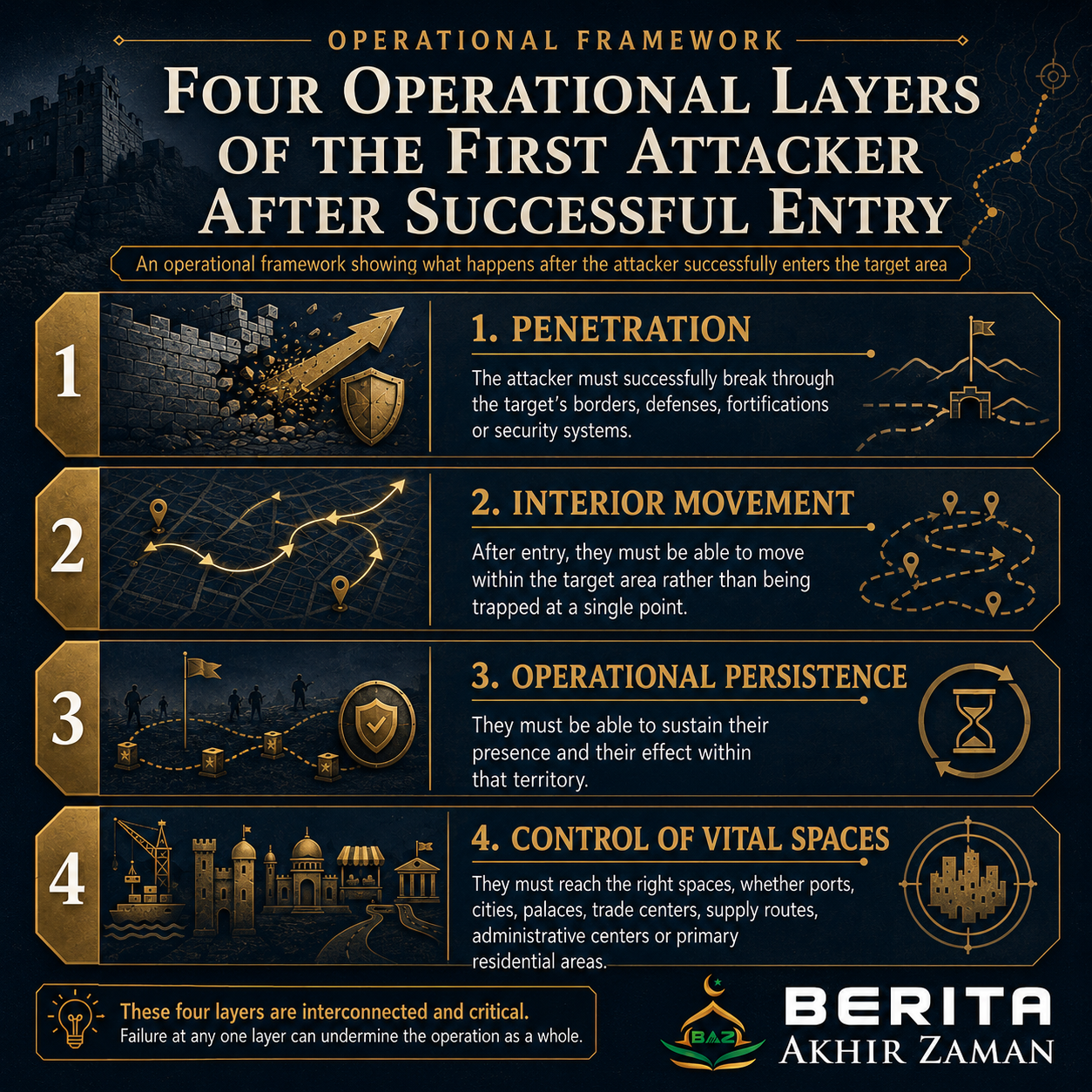
In a maritime or colonial context, if Nusantara is being tested as the location, this phrase becomes even more interesting. Colonial powers did not simply attack from the sea and then return. They entered ports. They built forts. They interfered in royal courts. They controlled trade centers. They broke local power networks. They restructured trade. They appointed residents. They changed laws. They collected taxes. They penetrated the states, not merely struck from the outside. In this framework, فَجَاسُوا خِلَالَ الدِّيَارِ can be read analytically as a picture of penetration into living space, not merely a surface attack.
In a land-based context, if the location being tested is continental, this phrase can describe an army entering cities, villages, main roads, houses, inner fortifications and centers of power until the attacked party loses its safe space. The meaning remains the same. The geographical form can change. But the operational characteristic remains constant: the attacker does not stop outside. They enter inside.
This also indicates that the attacker in this verse was not a small power. A small power can attack and withdraw. A small power can harass the edges. A small power can conduct limited raids. But to reach the level of فَجَاسُوا خِلَالَ الدِّيَارِ, the attacker must possess greater tactical and strategic capability. They must have planning. They must have an operational direction. They must know how to enter and how to move after entering. They must possess a strength that is not only hard, but effective.
In simple language, this characteristic shows that the attacker was not only strong enough to wage war. They were also strong enough to win inside enemy territory.
However, all of this must remain within safe limits. The verse does not mention the name of a city. The verse does not mention the type of weapon. The verse does not mention whether the attack came by sea, land or both. The verse also does not mention whether it was traditional, imperial, colonial or modern. All these modern illustrations are only attempts to translate the linguistic effect of فَجَاسُوا خِلَالَ الدِّيَارِ into tactical language that is easier to understand today. It is not the definitive meaning of the verse. It is the most fitting analytical reading based on the wording.
In conclusion, this phrase shows that the attacker in verse 5 did not merely possess severe might. They possessed a successful operational capability: the ability to penetrate the residential areas of the Children of Israel, move within their living space and make the punishment truly felt internally. This sharpens the profile of the attacker: not merely a strong power, but a power capable of entering, moving and controlling.
If summarized briefly, this sixth characteristic can be stated as follows:
The attacker was not only able to attack from outside. They had the ability to penetrate the residential areas of the Children of Israel, move within their living space and make the punishment real at an internal level.
Characteristic 7. Their Attack Reached Into the System of Life
The phrase:
فَجَاسُوا خِلَالَ الدِّيَارِ
shows that the attack did not only take place outside the main area. It was not merely a battle at the border, coastline, outer port, open battlefield or forward defensive zone. The verse depicts the attacker reaching the inner space, meaning the area that formed the dwelling place, center of life and protected space of the Children of Israel.
This is important because there is a major difference between winning in an outer battlefield and penetrating the center of life.
A power may win in open battle, but that does not necessarily mean it can enter residential areas. A power may defeat defensive forces outside, but that does not necessarily mean it can move within the lands, cities, villages, ports, palaces or administrative centers of the attacked party.
Yet this verse does not only describe an external victory. It describes internal penetration.
- They were able to break through outer layers of defense.
- They were able to enter spaces that should have been protected.
- They were able to move within the areas that constituted the diyar of the Children of Israel.
- They did not only defeat the front defenses. They reached deeper into the living space.
So the seventh characteristic of the attacker is this:
They were not only strong on the outside. They were able to enter the center of life of the Children of Israel.
Explanation
This characteristic makes the attacker’s profile much heavier. They were not merely a power that came to fight and then went back. They were not merely a power that launched a temporary attack. They were not merely a power that harassed from afar. They were a power capable of bringing the attack into the area that formed the lifeline of the punished party.
In modern military language, as an analytical reading and not the definitive meaning of the verse, this can be understood as operational depth. It means the attacker did not only win at the front line. They were able to penetrate defenses, enter inner spaces, move within the target area and affect the center of life of the party being attacked.
This requires more than courage. It requires planning, intelligence, entry routes, logistical control, the ability to move in foreign territory and the ability to sustain pressure after entry.
In the context of ordinary warfare, this can mean attacking forces entering cities, villages, main roads, centers of government and residential areas.
In a maritime context, this can mean that they did not merely attack from the sea, but entered ports, controlled trade routes, built forts and turned coastal areas into gateways for penetrating the land.
In a colonial context, this can mean that they did not merely win in war, but entered the system of life of the society. They controlled palaces, taxes, land, trade, ports, law, administration and political relations between states.
This is the major difference between external attack and internal penetration.
The phrase خِلَالَ الدِّيَارِ gives the picture that the attacker entered the midst of the living areas. They did not stand outside the fence of history. They entered the great house of that society’s life. They moved through spaces close to daily life, centers of power and the social structure of the party being attacked.
This is important for historical audit. A candidate attacker cannot be accepted merely because it was powerful. It is not enough to prove that they once fought the Children of Israel. It is not enough to prove that they won outside. The candidate must show that it truly entered the residential area or living space meant by the verse.
Therefore, the audit questions are:
Did they merely attack from outside, or did they truly enter the living space of the Children of Israel?
Did they merely win on the battlefield, or did they reach the centers of residence and power?
Were the effects of their attack temporary, or did it change the position of the Children of Israel in that territory?
Within the Nusantara framework, this characteristic is highly important. If the severe power is read as maritime colonialism or imperialism, then what must be examined is not only war at sea or attacks on ports. What must be examined is the extent to which that power entered the states, royal courts, trade, land, law, taxation and life of the society.
Because the verse does not only say that they came. The verse says that they penetrated through the midst of the diyar.
So this seventh characteristic can be summarized as follows:
The attacker did not merely win in an outer battlefield. They were able to penetrate the layers of defense, enter the inner space and reach the center of life of the Children of Israel. Any historical candidate that wishes to be linked to this verse must prove not only military strength, but also the ability to enter the diyar mentioned by the Qur’an.
Characteristic 8. They Came as an Instrument of the First Promise of Punishment
The verse states:
فَإِذَا جَاءَ وَعْدُ أُولَاهُمَا
Meaning:
Then, when the promise of the first of the two came.
Then the verse continues:
بَعَثْنَا عَلَيْكُمْ
Meaning:
We raised against you.
This sequence is very important. The attacker in verse 5 does not appear randomly. They do not come as a power standing alone in a historical vacuum. They come after a major condition has been mentioned in verse 4, namely that the Children of Israel would commit fasad on earth and rise with great uluww.
Therefore, this attacker is not merely “an enemy that attacks”. They are Allah’s instrument for the first promise of punishment.
The verse does not say:
When a strong nation came...
Instead, the verse says:
When the first promise came...
This means that the focus of the verse is not the name of the attacker. The center of the verse is the promise of Allah. The attacker is only the instrument that Allah raises when that promise arrives.
So the eighth characteristic of the attacker is this:
Their emergence must occur after the first fasad mentioned in verse 4.
Explanation
This is highly important for historical audit. We cannot choose the attacker first and then search for justification afterwards. The correct sequence is the opposite. We must first identify the framework of the first fasad, then evaluate which severe power came after it.
In simpler language:
The first fasad must come first.
The first promise of punishment must arrive after that.
Only then is the severe power raised against them.
If any candidate attacker does not come after a major fasad that can be linked to the Children of Israel, that candidate becomes weak. It may be strong militarily, but not necessarily strong according to the structure of the verse.
This is the mistake that often happens when this verse is immediately matched with a particular history. People immediately ask:
Who was the attacker?
Yet the verse forces us to first ask:
What was the first fasad?
If the cause is not clear, then the attacker cannot be finalized either.
The phrase وَعْدُ أُولَاهُمَا also binds this attack to the first cycle. It is not a general promise. It is not an ordinary punishment. It is the promise connected to “the first of the two”. As explained earlier, “the two” returns to مَرَّتَيْنِ, meaning the two instances of fasad in verse 4.
So this first promise can be summarized as follows:
It is the promise of punishment for the first fasad out of the two instances of fasad committed by the Children of Israel.
Therefore, the attacker in verse 5 must be tested based on its position in this sequence. They must appear as a power that comes after the first fasad, not before it. They must become an instrument of punishment, not merely a foreign power that happened to win. They must produce an effect that fits the closing of the verse:
وَكَانَ وَعْدًا مَّفْعُولًا
Meaning:
The promise truly took place.
If we want to test any historical attacker, several questions must be asked.
- What was the first fasad that occurred before they came?
- What form of uluww accompanied that fasad?
- Who were the Children of Israel targeted in that cycle?
- Where were their diyar at that time?
- What form of severe power was raised against them?
- Did that power truly enter their living space?
- Did the attack produce a major effect worthy of being called a fulfilled promise of punishment?
- After the attack, was there room for the structure of verse 6, namely that the Children of Israel were given a return of advantage, wealth, children and greater numbers?
The final question is highly important. Verse 5 also does not stand alone. After verse 5, verse 6 mentions restoration or a return of advantage to the Children of Israel. Therefore, the first attacker cannot be understood as the absolute end. There was an impact left behind. The attack was major, but after that there was still a further cycle within the structure of the verses.
In other words, the first attacker must satisfy two directions at once.
First, it must come after the first fasad.
Second, it must still leave room for the development of verse 6.
If a candidate attacker destroys everything until there is no room for the structure of verse 6, it must be audited again. If a candidate attacker has no clear relationship with the first fasad, it must also be audited again.
In a modern or colonial context, as an analytical reading and not the definitive meaning of the verse, this principle is very important. Suppose a colonial power is tested as أُولِي بَأْسٍ شَدِيدٍ. We cannot merely say that they had warships, cannons and great strength. That only answers the characteristic of severe power. We still need to answer the structural questions:
- What was the first fasad that preceded their arrival?
- What form of uluww took place before the punishment?
- Why can their arrival be regarded as the first promise of punishment?
- What happened after that, such that verse 6 can still be read within the historical sequence?
This makes the analysis more disciplined. It prevents us from choosing the attacker merely because they were strong. Strength alone is not enough. The attacker must arrive at the right point within the structure of the verse.
So this eighth characteristic can be summarized as follows:
The attacker in verse 5 is not a random power. They are an instrument of the first promise of punishment. Their emergence must occur after the first fasad of the Children of Israel and their attack must leave room for the sequence of the following verse.
In conclusion, وَعْدُ أُولَاهُمَا is a methodological boundary. It prevents us from naming the attacker without understanding the cause of the punishment. It teaches that before asking who attacked, we must know what fasad caused the first promise of punishment to arrive.
If the first fasad is not clear, then the first attacker also cannot be finalized.
Characteristic 9. They Do Not Necessarily Come From One Specific Direction
Verse 5 does not mention where the attacker came from. The verse does not mention north, south, east or west.
Verse 5 also does not mention whether they came by land or by sea.
Verse 5 also does not mention whether they came through a river, strait, desert, mountain, port or any specific route.
What the verse mentions is only:
بَعَثْنَا عَلَيْكُمْ عِبَادًا لَّنَا أُولِي بَأْسٍ شَدِيدٍ
Meaning:
We raised against you servants belonging to Us who possessed severe might.
Then the verse states:
فَجَاسُوا خِلَالَ الدِّيَارِ
Meaning:
They then penetrated through the midst of the dwellings.
This gives us an important method. The direction of attack cannot be forced into the verse when the verse itself does not mention it. We cannot say that the attacker must come from the north, must come from the west, must come by land or must come by sea solely based on a historical assumption already held beforehand.
The verse gives characteristics, not direction.
The verse gives the attacker’s profile, not a map of their route.
So the ninth characteristic of the attacker is this:
The direction and form of the attack are not mentioned by the verse, but their capability must suit the form of the location.
Explanation
This is highly important in auditing the location. If the location being tested is a land territory, then the most suitable attacker must have land capability. They must be able to move through land routes, penetrate cities, control roads, besiege territories and enter residential areas through a land-based structure.
If the location being tested is coastal, archipelagic or maritime, then the most suitable attacker is not necessarily a land army. They must possess naval capability, ships, sailing routes, maritime logistics, control of ports and the ability to project power through networks of water.
If the location being tested is an inland area, then the attacker must have the capability to penetrate inland routes. They must be able to move through rivers, forests, hills, valleys, roads or supply lines that allow them to reach the living space of the target.
Thus, the form of attack must follow the form of the location.
This too is not the definitive meaning of the verse. It is an analytical reading based on the wording of the verse. The verse does not mention geography directly, but it does mention the capability of the attacker. Therefore, when a location is tested, the attacker’s capability must correspond to the geography of that location.
In modern tactical language, this can be called suitability of force to terrain. It means that a power is not enough simply by being strong. Its strength must be suited to the terrain it is trying to penetrate.
A power that is strong in the desert is not necessarily suited to an archipelagic region.
A power that is strong on land is not necessarily able to control straits.
A power that is strong at sea is not necessarily able to enter the interior.
A power that is strong from the air is not necessarily able to control residential areas if it lacks land capability or local networks.
Therefore, when the verse mentions أُولِي بَأْسٍ شَدِيدٍ, we do not only ask whether they were strong. We must also ask:
Strong in what terrain?
Strong through which route?
Strong in what manner?
Strong enough to enter the diyar through the geographical form being tested?
This is where the verse becomes very precise. It does not give the name of a location. It does not give the direction of attack. It does not give the type of entry route. Instead, it gives a general characteristic that must be tested against every location.
If someone chooses Jerusalem as the location, they must show an attacker suited to the geography of Jerusalem. How did they come? From which direction? Through which land route? How did they penetrate the residential areas? How did the attack fit خِلَالَ الدِّيَارِ?
If someone chooses Nusantara as the location, they too must pass the same test. How did the attacker come? Through the sea? Through ports? Through straits? Through trade centers? How did they enter the residential areas, states, royal courts, laws, economy and living space of the society?
The method must be the same. Jerusalem cannot be accepted merely because it is widely held. Nusantara cannot be accepted merely because it appears fitting. Every location must be tested against the wording of the verse.
However, if the context being tested is Nusantara, then the most logical form of attacker from a geographical perspective is maritime power. Nusantara is a world of straits, islands, ports, coasts, sea trade and kingdoms connected through water routes. Therefore, the severe power that comes against such a region is more fittingly understood as a power capable of controlling the sea, ports, trading vessels, spice routes, coastal forts and maritime political networks.
Within that framework, maritime colonialism and imperialism become very strong candidates to be tested. Not because the verse mentions colonialism. The verse does not mention it. Rather, because the characteristics of the verse demand a power capable of coming against the Children of Israel, bringing severe might and entering through the midst of the diyar. If that diyar is located in an archipelagic world, then a power entering through ships, cannons, ports, armed trading companies and colonial administration corresponds more closely to its geographical form.
On the other hand, if we force a purely land-based attack model upon a maritime region, the analysis becomes weak. It may suit a continent. It may suit a land city. But it is not necessarily suitable for islands, ports and networks of sea routes.
Therefore, this verse teaches us not to force a direction.
The verse does not say the attacker came from the north.
The verse does not say the attacker came from the west.
The verse does not say the attacker came from the east.
The verse does not say the attacker came by sea.
The verse does not say the attacker came by land.
However, the verse demands one thing:
the attacker must have the capability suited to entering the living space of the Children of Israel in the location being tested.
That is the measure. In historical audit, the questions that need to be asked are:
Did the attacker have a route to reach the target area?
Did they have the logistics to maintain pressure?
Did they have technology suited to the terrain?
Did they have the ability to penetrate residential areas?
Was the form of their attack suited to the geography of the location?
Did they truly enter the living space, rather than merely harass from outside?
These questions are more important than immediately choosing a direction.
In conclusion, this ninth characteristic prevents us from locking the verse to an unproven map. The direction of attack is not mentioned. The entry route is not mentioned. The type of terrain is not mentioned. What is mentioned is the attacker’s capability and the effect of their attack.
So this characteristic can be summarized as follows:
The attacker in verse 5 does not necessarily come from one specific direction. The verse does not mention north, south, east, west, land or sea. However, when any location is tested, the form of the attacker’s strength must correspond to the geography of that location. If the location is land-based, land power must be proven. If the location is maritime, naval power and maritime logistics must be proven. If the location is inland, the ability to penetrate inland routes must be proven. Without a match between strength and location, the candidate attacker is not strong enough.
Characteristic 10. They Caused the Promise to Truly Take Place
Verse 5 closes with:
وَكَانَ وَعْدًا مَّفْعُولًا
Meaning:
The promise was one that was carried out.
The closing of this verse is highly important. It shows that the attack in verse 5 was not merely a threat from Allah. It was not merely initial pressure. It was not merely a fear that did not reach its outcome. It truly took place until Allah’s promise became a reality in history.
The word مَّفْعُولًا carries the meaning of something made, done or carried out. Therefore, the promise was not only spoken. It was not only given as a warning. It reached the level of execution.
In other words, the attacker in this verse was not merely coming to attempt. They were not merely coming to threaten. They were not merely launching a small attack and then failing. They became the instrument that caused the first promise of punishment to truly occur.
So the tenth characteristic of the attacker is this:
They succeeded in producing the effect of punishment mentioned by the verse.
This is a highly important characteristic for historical audit. A candidate attacker is not enough merely by being strong on paper. It is not enough merely by having an army. It is not enough merely by having threatened the Children of Israel. It is not enough merely by having fought them. That candidate attacker must leave a major impact so that the attack is worthy of being called a fulfilled promise.
The effect must be real, felt and capable of changing the condition of the Children of Israel in that first cycle.
However, this effect does not necessarily mean that the Children of Israel were destroyed forever. This is important because the following verse, verse 6, states that the Children of Israel were given a return of advantage. Therefore, the first punishment in verse 5 was not the absolute end of their existence. It was a major punishment, but it was still followed by another cycle.
This means the first attack must be significant enough to bring down, subdue, pressure or shake their position. At the same time, it must not close the door to the structure of verse 6, in which they return to a position of advantage, wealth, children and greater numbers.
In simple language:
The attack must succeed.
The attack must be major.
But the attack is not the final end.
Explanation
If read within a modern or military-historical framework as an analysis, not as the definitive meaning of the verse, the phrase وَعْدًا مَّفْعُولًا demands strategic effect. This means the attack cannot be evaluated only by the event of war itself. It must be examined through the major changes that followed the war.
Was their center of power shaken?
Was their territory entered?
Did their security system collapse?
Was their leadership pressured?
Did their economy change hands?
Were their land, trade, ports or administration controlled?
Was their life no longer the same after that?
If yes, then the attack becomes more worthy of being read as a punishment that truly took place.
In the context of colonialism and imperialism as an analytical example, not a definitive identification, this characteristic is very clear. Colonial powers did not merely come to fight. They left long-term effects. They controlled ports. They altered trade. They pressured royal courts. They built forts. They took natural resources. They arranged taxes. They changed laws. They entered administration. They restructured social life. They left an impact upon political structures, administration and systems of governance after colonial rule.
That was not an empty threat. It was a historical transformation. Therefore, if colonialism is tested as a candidate for أُولِي بَأْسٍ شَدِيدٍ in a maritime region such as Nusantara, the characteristic of وَعْدًا مَّفْعُولًا requires us to ask:
Did their arrival truly change the position of the Children of Israel in that territory?
Did they merely come to attack, or did they truly control the living space?
Were their effects large enough to be called a historical punishment?
After that, was there still room for a cycle of restoration as mentioned in verse 6?
These questions prevent us from making a match too quickly.
Because not every power that attacks succeeds in fulfilling the promise.
Some powers come but fail.
Some powers are strong but do not enter the diyar.
Some powers win once but do not leave a major impact.
Some powers disturb but do not change the structure of history.
The candidate attacker in verse 5 must be more than that. They must become the power that causes the first promise to truly take place.
Within the audit framework, this characteristic can be tested through several signs:
First, the attack brings a clear effect upon the position of the Children of Israel.
Second, its effect is not small or merely temporary.
Third, the attack causes the target to lose control at a certain level.
Fourth, their living space is entered or controlled.
Fifth, after the attack there is a major change in their political, economic, territorial or social structure.
Sixth, the attack still remains within the framework of the first cycle because verse 6 shows developments after it.
The sixth point is highly important. If an event is considered the first promise, then there must be room for verse 6 after it. Otherwise, the structure of the verses is broken.
Thus, the phrase وَكَانَ وَعْدًا مَّفْعُولًا is not merely the closing of the verse. It is a marker that everything mentioned before it has reached its outcome. The first promise came. Allah raised His servants who possessed severe might. They entered through the midst of the diyar. Then the promise truly took place.
In conclusion, the attacker in verse 5 must possess a real historical impact. They are not merely an army that came. They are the power that succeeded in making the first promise of punishment happen in reality.
If summarized concisely, this tenth characteristic is as follows:
The attacker must produce an effect of punishment that truly takes place. They are not merely threatening, not merely attacking from outside and not merely winning a small victory. They must leave a major impact upon the Children of Israel in the first cycle, but not as the final end because verse 6 shows that there is still a return of advantage after that.
A Concise Profile of the Attacker Based on the Verse
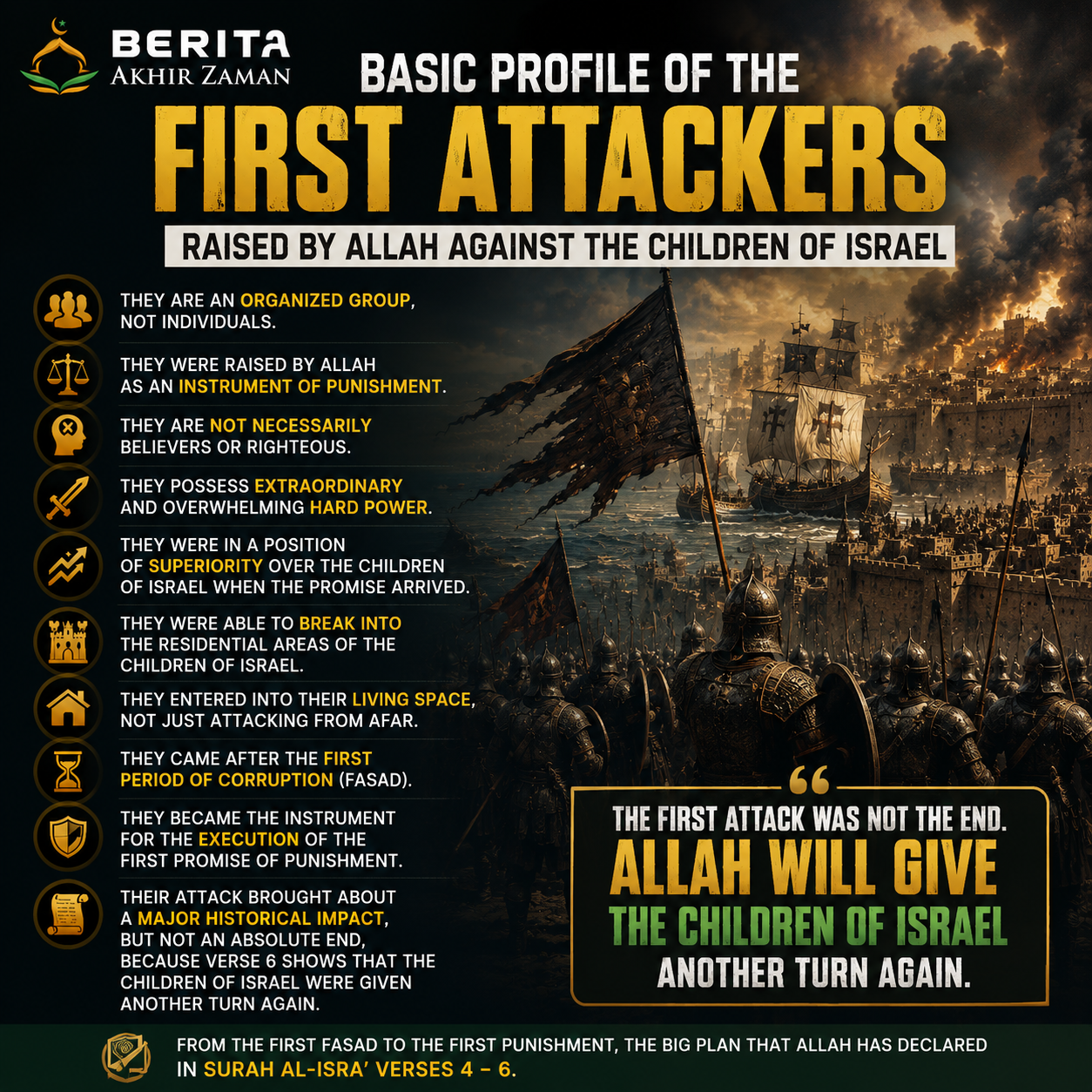
When all the elements of verse 5 are gathered, we can construct a basic profile of the first attacker that Allah raised against the Children of Israel. That profile can be summarized as follows:
- They were an organized group, not an individual.
- Allah raised them as an instrument of punishment.
- They were not necessarily believers or righteous people.
- They possessed extraordinary severe might.
- They were in a position of advantage over the Children of Israel when the promise arrived.
- They were able to penetrate the residential areas of the Children of Israel.
- They entered the living space, not merely attacking from afar.
- They came after the first fasad.
- They became the instrument for the execution of the first promise of punishment.
- Their attack produced a major historical impact, but it was not the absolute end because verse 6 shows that the Children of Israel were given a return of advantage.
Conclusion
This is why this chapter is titled “The Profile of the Group That Attacked the Children of Israel the First Time.” Surah al-Isra’ verse 5 is building the profile of a severe power that Allah raised against the Children of Israel when the first promise of punishment arrived. They were not merely an ordinary enemy. They were an organized group, possessing severe might, capable of penetrating the residential areas and leaving a major historical impact.
Through this analysis, we have built an important framework for understanding the first of the two attacks mentioned in Surah al-Isra’. The first attack is not merely a story of one power attacking the Children of Israel. It involves the profile of the attacker, the nature of their strength, the way they entered the residential areas and the land that became the target of punishment.
Within the framework of this study, these characteristics further strengthen the reading that the era of Western imperialism over Nusantara is the most fitting form of the first attack described in verse 5. Western powers came with fleets, cannons, armed trading companies, control over ports, political treaties, interference in royal courts, economic control and colonial administration. They did not merely attack from the outside. They entered into the diyar, meaning the living space, economy, law, land, ports and systems of governance of the society.
This reading also strengthens the larger framework of the study, namely that the land once promised to the Children of Israel is more fittingly located in the Malay Peninsula and Nusantara, not Jerusalem. This conclusion cannot be taken lightly. It must be built upon the wording of the verse, the characteristics of the land, the history of the Children of Israel, the form of punishment and the profile of the power that attacked them.
This understanding must be corrected because Surah al-Isra’ does not stop at the first attack. The verse opens a framework of two cycles of fasad and two cycles of punishment. If the first attack has already occurred in history, then the second attack will also arrive at its appointed time. When the map of the first attack is misplaced, the map of the second attack will also easily go astray.
That is why we must return to the Qur’an with greater precision. We must not only ask who attacked. We must also ask which land was attacked, why the punishment came and how the first attack becomes the key to understanding the second attack that will come later.

Reply to: